
Family offices deployed $12.9 billion into direct investments in 2025, more than double the prior year. That growth has created a second credible route into professional investing. This guide compares the two on mandate, deal flow, day-to-day work, compensation, and career optionality.
A traditional venture fund raises capital from limited partners under a partnership agreement that fixes the fund size, the investment period, the fee, the carried interest, and the point at which capital must be returned. Every underwriting decision is made against that schedule.
A single family office invests capital that already belongs to the family, typically created through an operating business or a liquidity event. There are no outside limited partners, no fundraising cycle, and no contractual deadline for exits. Decision rights usually sit with a principal or a small investment committee.
Family office direct investing doubled in 2025, and North America absorbed half of it
S&P Global Market Intelligence recorded 158 family office direct transactions worth $12.9 billion in 2025, a 123.3% increase in value over 2024 and the highest annual total since at least 2021. That figure excludes capital committed through private equity and venture funds, so it measures direct deal activity specifically.
Participation is broad rather than concentrated in a handful of large offices. Citi's 2025 Global Family Office Report found that 70% of respondents were engaged in direct investing, with 40% of those having increased that activity year over year. BNY's 2025 study of single family offices found 64% expecting to make six or more direct investments in the following twelve months.
Venture is one allocation among several, which shapes the job description
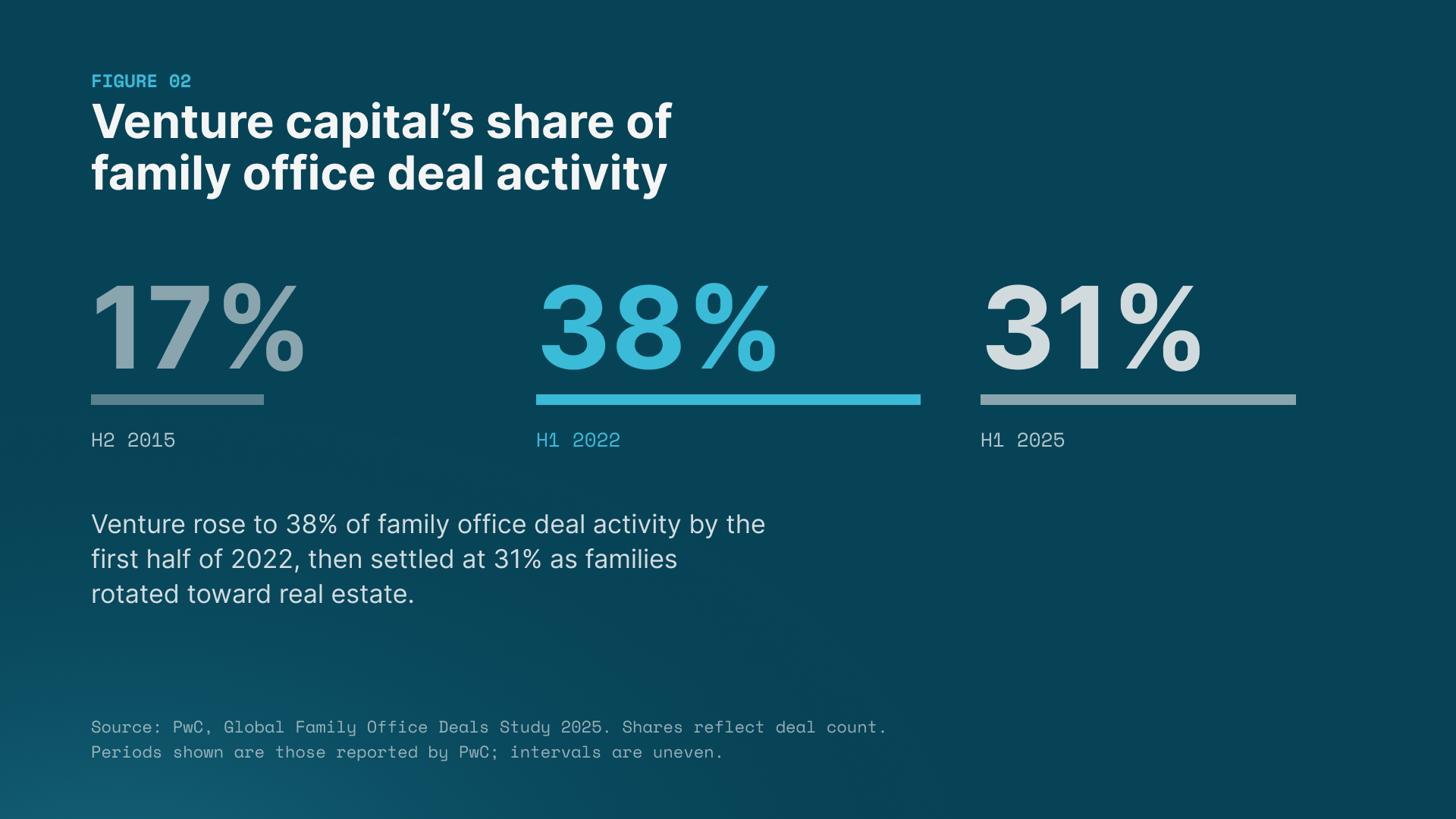
Deal-count data from PwC's Global Family Office Deals Study shows where family office attention actually goes. Venture is a substantial share of activity and competes directly with real estate and private equity for the same capital and the same analyst hours.
The venture share has also moved through a full cycle. PwC tracked it rising from 17% of family office deal activity in the second half of 2015 to 38% by the first half of 2022, then settling at 31% in the first half of 2025 as families rotated toward real estate.
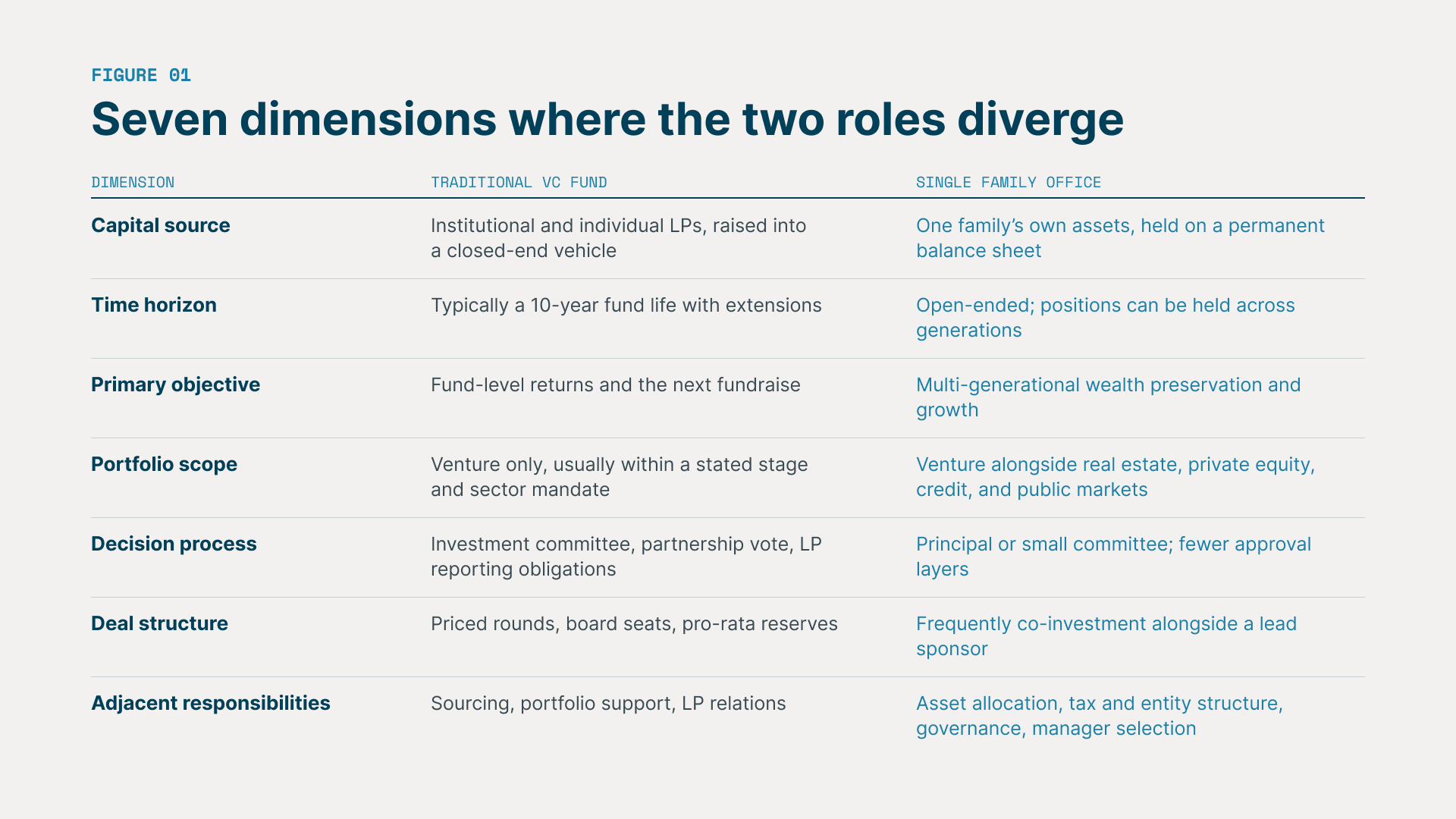
The daily work overlaps; the surrounding responsibilities do not.
Sourcing, diligence, market mapping, founder meetings, and memo writing are common to both roles. The difference shows up in what an investor is accountable for beyond the deal.
At a venture fund
Work is organized around the vehicle: deploying the investment period on schedule, managing reserves for follow-ons, supporting portfolio companies through subsequent rounds, marking the book, and contributing to LP reporting and the next fundraise. Specialization is expected, and 2025 deal data shows how narrow the market's focus has become. NVCA and PitchBook recorded 15,352 US venture deals worth $320 billion in 2025, with AI companies taking 65.4% of total deal value.
At a family office
Venture underwriting sits alongside allocation work. An investor may be asked to size the venture sleeve against real estate, evaluate an external fund manager, structure a co-investment through the right entity, model the tax and liquidity consequences, and brief a principal or a next-generation family member. Co-investment alongside a lead sponsor is the common structure, which shifts the skill emphasis toward evaluating other investors' underwriting rather than originating every deal independently.
Sector focus often follows the family's own operating history. An office built on industrial wealth tends to underwrite manufacturing and logistics technology, where the family's operating knowledge is an underwriting advantage rather than a preference.
Compensation: comparable cash at junior levels, different mechanics for upside
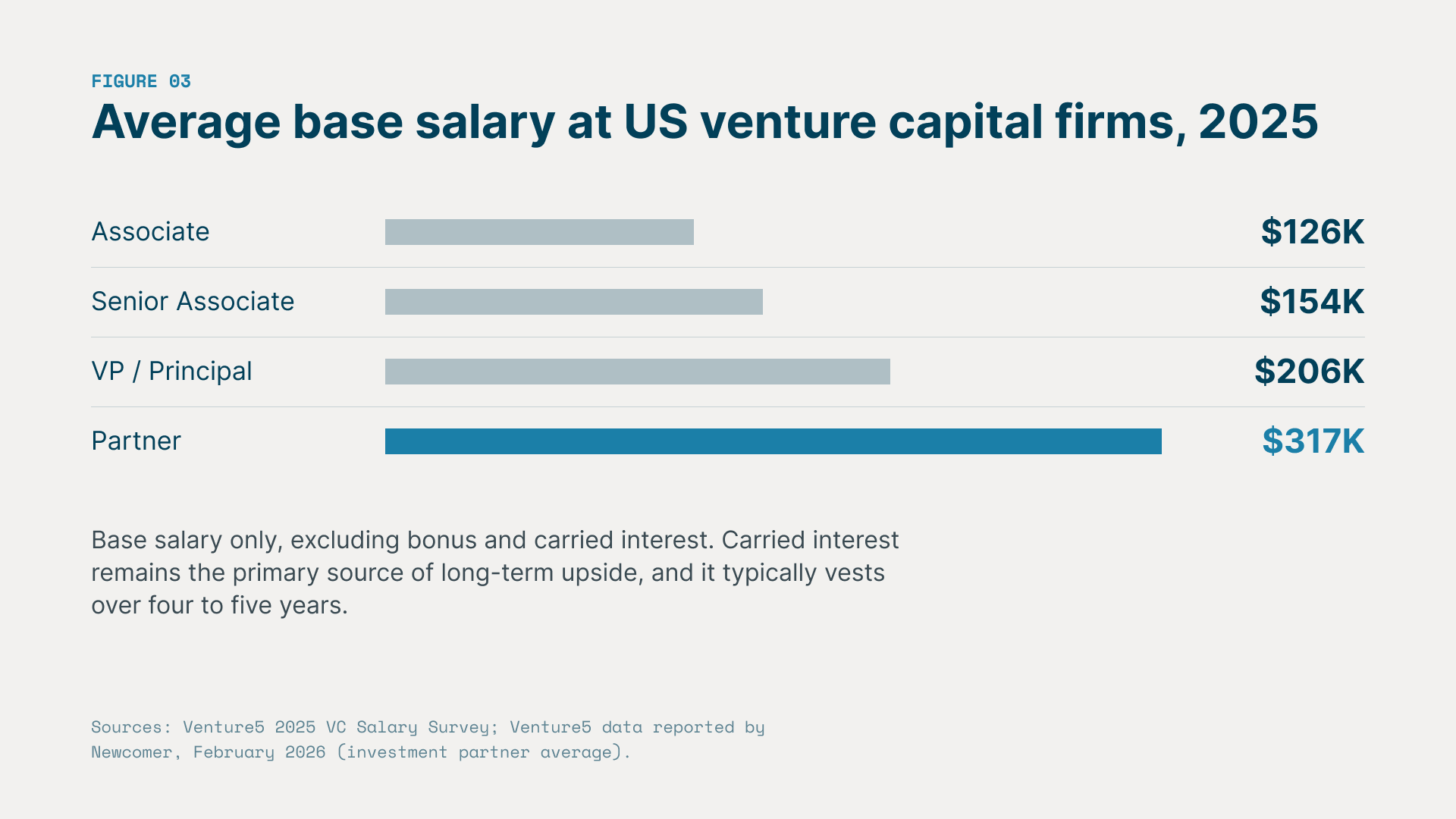
Venture5's 2025 salary survey, covering more than 700 professionals across 50-plus firms, reported average base salaries declining year over year below partner level. Carried interest remains the primary source of long-term upside, and it typically vests over four to five years.
Family office pay is benchmarked differently, usually as total compensation and indexed to assets under management. Published summaries of the 2025 KPMG Private Enterprise and Agreus benchmark put median total compensation in US single family offices at roughly $125,000 for an analyst and roughly $900,000 for a chief investment officer, with about 90% of offices offering an annual bonus.
These two datasets measure different things. The venture figures above are base salary; the family office figures are total compensation. Compare them only at the level of structure, not dollar for dollar.
The structural change worth noting for candidates is in long-term incentives.
For a candidate, the practical question in either setting is the same: how much of the package is contractual cash, how much depends on realized performance, and how long the vesting or holding period runs before any of it converts.
Which background maps to which path
Venture funds recruit predominantly from investment banking, consulting, operating roles at growth-stage technology companies, engineering, and founder experience. Sourcing capability and sector credibility carry most of the weight.
Family offices recruit from a wider set, because the mandate is wider. Common entry points include private banking and wealth management, private equity, corporate development, tax and trust advisory, real estate, and senior roles within the family's own operating business. Offices founded by first-generation entrepreneurs favor candidates who can evaluate concentrated positions in industries they already understand.
Headcount growth supports both routes. Deloitte counted approximately 8,030 single family offices globally in 2024, up from 6,130 in 2019, with North American offices approaching 3,200 and projected to reach roughly 4,200 by 2030.
A decision framework
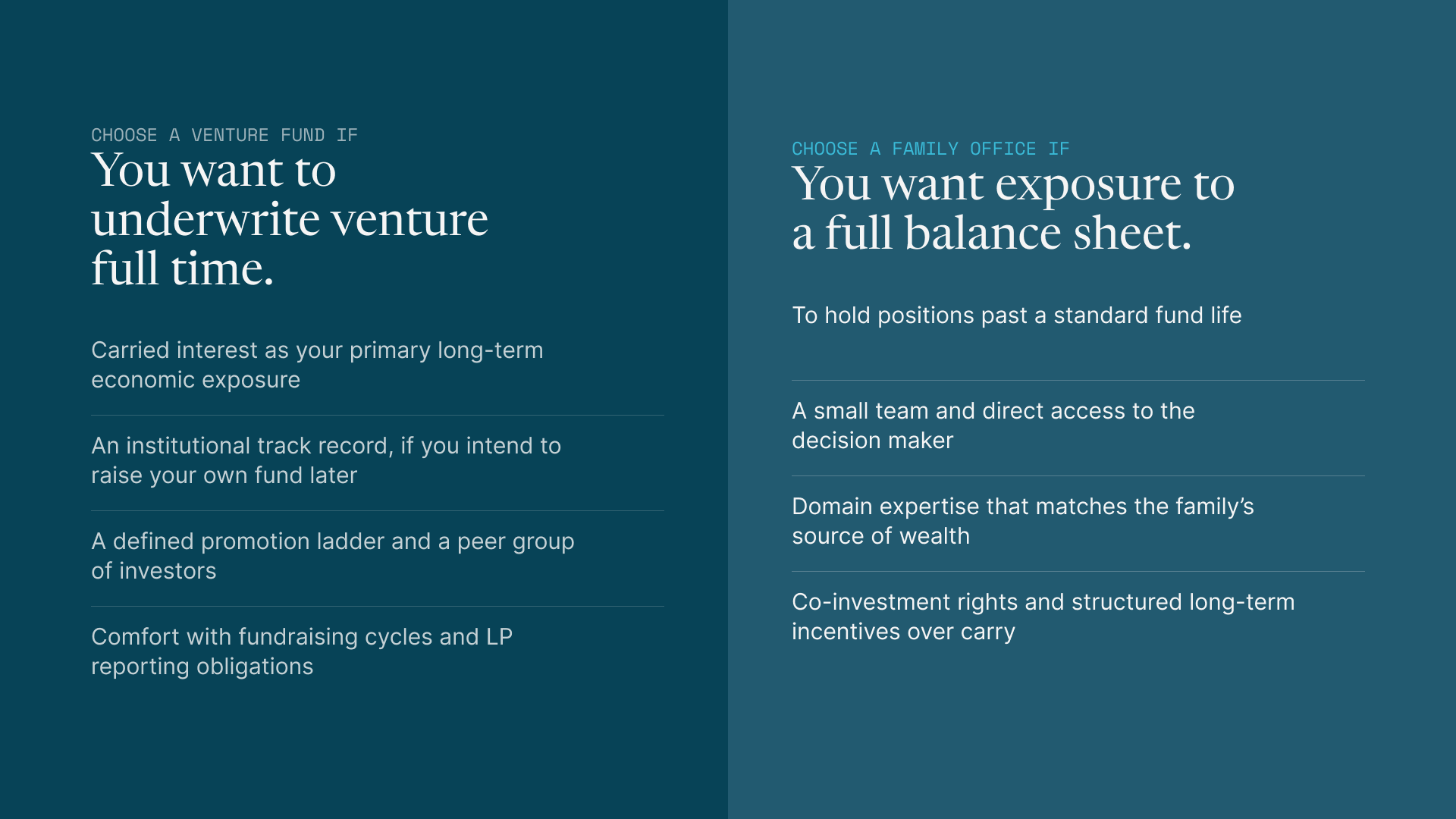
Choose a venture fund if
- You want to underwrite venture full time, without allocation or governance responsibilities
- You want carried interest as your primary long-term economic exposure
- You intend to raise your own fund later and need an institutional track record
- You want a defined promotion ladder and a peer group of investors
- You are comfortable with fundraising cycles and LP reporting obligations
Choose a family office if
- You want exposure to a full balance sheet, including private and public markets
- You want to hold positions past a standard fund life
- You work well with a small team and direct access to the decision maker
- You bring domain expertise that matches the family's source of wealth
- You value co-investment rights and structured long-term incentives over carry
Movement between the two paths is common
The capital relationship connects them. Family offices and high-net-worth investors accounted for roughly 39% of venture fund capital and 27% of buyout fund capital across a sample of funds raised between 2020 and 2026, according to analysis published by First Citizens. Offices that commit to funds as limited partners meet fund managers continuously, and hiring moves in both directions: fund investors join offices to run direct programs, and office investors raise funds using their track record and family anchor capital.
A useful way to test the choice before committing is to ask what a specific role will make you accountable for after eighteen months. If the answer is a portfolio of venture positions and a reserve strategy, that is fund work. If the answer includes an allocation model, an external manager review, and a governance calendar, that is family office work. Both are investing careers, and the underwriting skill transfers; the surrounding responsibilities are what you will be evaluated on.
Interested in the full research paper?
Join to receive Venture Capital research, guides, models, career tips, and many other great insights delivered straight to your inbox.