"I think the thing that really helped me be interesting to venture funds was that I was already very involved in the ecosystem. It was as simple as reaching out to folks at companies that I was excited about." — Sree, Founder of Conduit, Former Associate at The Partnership Fund for NYC

Most aspiring VCs approach breaking in the same way: polish the resume, apply to open roles, hope someone responds. It rarely works. Not because the background isn't there, but because the strategy is backwards.
The investors and operators who successfully land roles in venture don't wait for a job posting. They build. They give. They show up — consistently, genuinely, and long before anyone is hiring.
Relationships, in venture capital, aren't a soft skill. They are the skill.
Why Networking Actually Works (And Why VC Is Different)
There's no shortage of career advice telling you to "network more." But in venture capital, this isn't generic advice — it's structural reality.
Deals come through relationships. LPs commit through trust. Founders choose investors they know. Even hiring is largely referral-driven. The entire industry runs on who knows who, and more importantly, who trusts who.
Research supports this. Studies consistently show that a majority of professionals find opportunities through personal contacts rather than formal applications — and that networking correlates directly with salary growth over time. In a small, high-stakes industry like VC, where there are roughly 3,400 active investors in the US and a fraction of that in open roles at any given time, the math becomes even more unforgiving.
Getting in through a cold application alone is possible. Getting in because someone vouches for you? That's the norm.
Start 18 Months Before You Think You Need To
When Sree was still in investment banking at JPMorgan, she already knew she wanted to move into venture. But rather than waiting until she was ready to leave, she started building quietly and deliberately.
"I started my recruiting process almost 18 months to two years before I was even thinking about leaving," she said. "The entire process was a learning process. I wanted to use that time to really immerse myself in the ecosystem and then figure out what part I really belonged in."
That timeline is more than a tactical choice. It's a philosophy. Relationships built under no pressure are fundamentally different from relationships built when you need something. People can feel the difference.
By the time Sree was actively recruiting, she wasn't a stranger asking for a job. She was already a familiar, trusted presence in the rooms that mattered.
The Giving Mindset: Add Value Before You Ask
The most common mistake aspiring VCs make in networking is leading with what they want. A job. An intro. A coffee chat. The ask arrives before the relationship does.
Sree frames it differently. Her goal, from the start, was never to get a job — it was to become genuinely useful.
"Being able to add value to a conversation is so critical versus just thinking about what can this person do for me," she said. "You want to make sure you're coming off in a very genuine way versus just seeming like you want a job in VC. That's not good enough and doesn't really tell anyone about who you are or why you want this job or what you're going to provide."
The benchmark she sets is a specific one: "They should never ask you, 'Why should I hire you?' That should never be an option. The question should be: 'It's amazing, you've done so much for us already — we'd love to find a way to work with you.' That's the golden statement."
This is what Keith Ferrazzi calls the giving mindset in Never Eat Alone — making sure your first instinct is to help others, not to calculate what you'll get in return. In practice for a VC aspirant, this means: share a memo on a sector they invest in. Make an intro they'd find valuable. Flag a founder you think fits their thesis. Show up to their events not to pitch yourself, but to contribute.
One tactical note: when you do make an ask, make it specific. "Can you help me break into VC?" is hard to act on. "I'm targeting early-stage fintech funds in New York — would you be open to a 20-minute call?" is easy.
Map the Ecosystem, Not Just the Firms
Most people targeting VC focus on the fund itself — the partners, the associates, the open roles. Sree's approach was more layered.
"I wanted to work at XYZ funds, but I used to think: who are their portfolio company founders? What sectors are they interested in? And prep before every conversation I had with anybody at that fund."
This is the insight most people miss. Breaking into a fund doesn't have to start at the fund. It can start with their portfolio founders. Those founders know the partners. They talk. And if you've added real value to a founder in a firm's portfolio, you've just created a warm introduction that no cold email could replicate.
"Find a list of startups across the portfolios of the venture funds, get in touch with those founders, and figure out what their problem areas are — and just help them with as much as you can," Sree said. "Become a really valuable resource to them and then break into the venture fund that way. I've seen so many people do that."
This approach also builds something more durable than a job lead: it builds operating empathy. The more time you spend with early-stage founders, the better you understand what they actually need from an investor — and that understanding is exactly what venture funds are hiring for.
One Conversation Can Change Everything
Sometimes it isn't a campaign. Sometimes it's a single moment — but one you were ready for.
In 2016, as Brexit uncertainty loomed over financial markets, Imran Tehal was building his career in banking. A director at his firm gave him advice that would quietly redirect everything: "You need to go into technology. That's where the future is."
At the time, the expected path was banking or consulting. Tech felt like uncharted territory. But Imran took the advice seriously — he started reading, surrounding himself with people in the space, and eventually found himself in the same room as someone working in venture capital. A field he hadn't even heard of.
"I just went up to him and said, 'Look, I like what you do and want to learn more.' He took me under his wing and connected me to his firm. That's how I got hired," Imran recalls.
No formal application. No polished pitch. Just a genuine expression of curiosity, at the right moment, to the right person — a moment Imran was only in because he'd followed the advice of someone who believed in him.
That's the compounding nature of relationships in venture. One mentor points you in a direction. One conversation opens a door. But neither happens if you're not in the ecosystem, showing up, and paying attention.
The Mentors Who Shape You
Relationships in venture aren't just about getting in. They're about who you become once you're there.
Sharran Deora, GoingVC alumnus and now an investor who sees roughly 5,000 deals a year, came into VC with a strong background across investment banking, product management, and entrepreneurship. Interviews came easily. Offers didn't — at least not at first.
What changed things wasn't a credential or a better resume. It was what he learned from the people around him. John Gidding modeled trust and transparency as the foundation of every investor relationship. Steve O'Hara showed him what relationship-driven investing actually looked like at a high level. SC Moharir demonstrated the relentless energy required to win deals without the advantage of a big brand behind you.
Sharran didn't copy any of them wholesale. He studied what each person did well, identified what fit his own natural approach, and integrated those lessons deliberately into his own style. The result was a version of himself that was sharper, more self-aware, and far better aligned with what the right firms were actually looking for.
The takeaway: mentors in VC aren't just connectors. They're mirrors. The right ones help you see where your strengths are, where your gaps are, and which version of this career actually fits you.
Seek them out. And when you find them, be the kind of person worth mentoring — curious, prepared, and genuinely committed to the work.
Your Personal Brand Is a Sourcing Tool
There's another underrated path that Sree raises: building in public.
"You can continue to build your own personal brand as a thought leader, create content in that domain, and then get surfaced by one of these people," she said. "I think that's really valuable."
In a world where partners are constantly looking for people who understand specific verticals deeply, a well-articulated point of view — a memo, a newsletter, a LinkedIn post that shows genuine insight — can bring the right people to you. It signals seriousness, demonstrates domain knowledge, and starts conversations that wouldn't happen otherwise.
Pick a vertical. Develop a thesis. Write about what you're seeing. Share it where the people you want to meet are already reading.
Venture Capital Networks Are Global
One of the things Sree built with Conduit — the platform she co-founded connecting operator investors with founders worldwide — was a direct response to a gap she saw firsthand: great founders exist everywhere, but the relationships connecting them to strategic capital don't always follow.
"There are incredible founders and future founders all over the world," she said. "They just aren't getting connected to the really strategic angels and operator investors."
The implication for aspiring VCs is worth absorbing: your network doesn't have to be local, and your opportunity set is bigger than New York or San Francisco. Emerging ecosystems in Latin America, Africa, and Southeast Asia are places where early relationship-builders will have lasting advantage.
Don't limit your outreach to the obvious hubs. And don't be discouraged by non-responses. People in this industry are busy. It's rarely personal. A polite, specific ask almost never hurts to send.
Putting It Into Practice
A few concrete steps if you're building your VC network right now:
Start a target fund map. List 10–15 firms you're genuinely interested in. For each: what stage do they invest at, what's their portfolio, who's on the team, and what expertise seems missing? That gap is your entry point.
Go through the portfolio. For each target fund, identify three to five portfolio founders in your domain. Reach out. Offer something useful. Build that relationship before you ever mention a job.
Make your asks specific. "I've been thinking about the payments space and would love to share a quick memo — would you be open to feedback?" opens more doors than "I'd love to learn more about what you do."
Build in public. Write the memo. Post the observation. Develop a point of view in a domain and share it where the right people will see it.
End every conversation well. "Is there anyone else you think it would be useful for me to speak with?" is one of the most compounding questions you can ask.
VC Is Not Binary. Relationships Compound.
Sree's closing thought from our conversation is one worth sitting with:
"VC is not binary, and relationships compound over time. When you are reaching out to folks and trying to find ways to potentially collaborate, you should always try to add value. People shouldn't be asking, 'Why should I hire this individual?' — rather, they should say, 'I really want to work with this person, and we should find a way to collaborate.' That, in my mind, is the golden statement."
Breaking into venture is less about credentials and more about presence. Show up early. Give before you ask. Build relationships that are genuine, specific, and sustained. The offer, when it comes, will feel less like luck — and more like the natural result of the work you've already done.
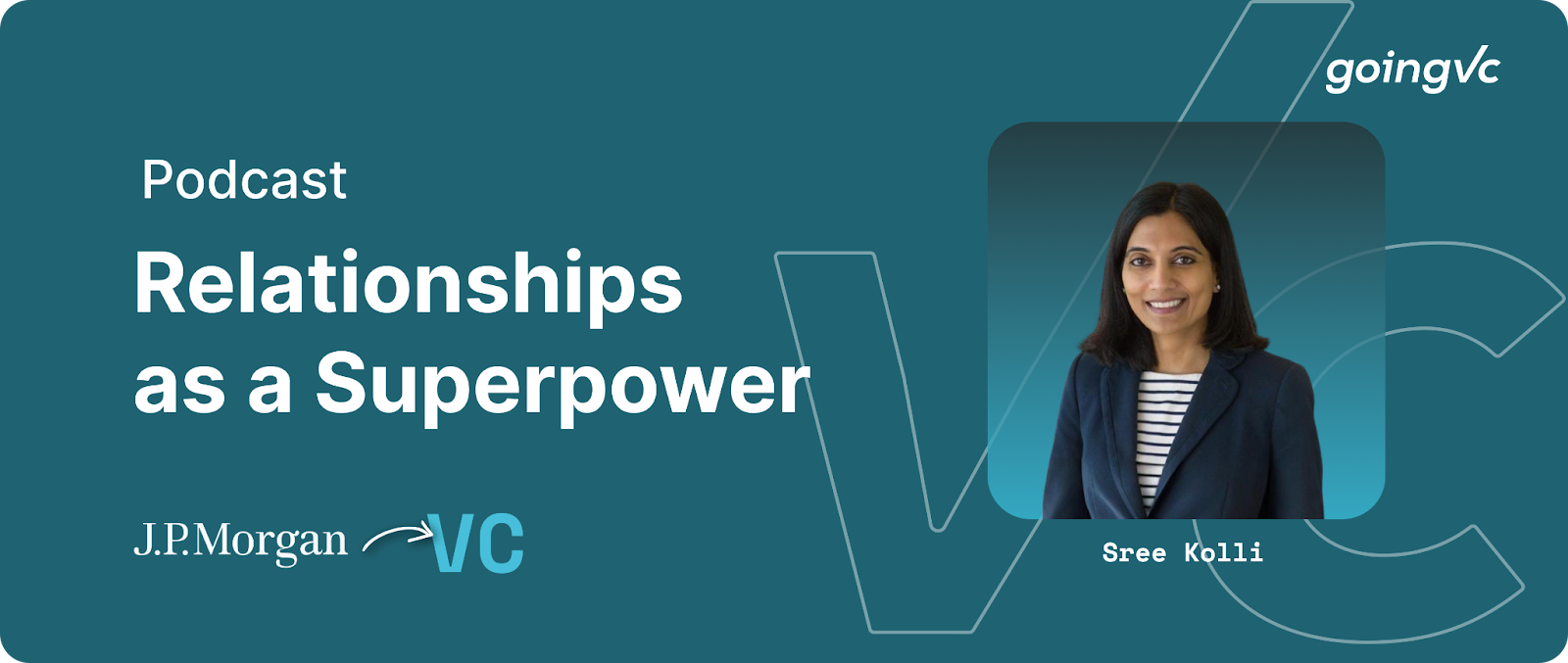
🎧 Listen to the full conversation with Sree on the GoingVC Podcast — including her experience transitioning from JPMorgan to venture, what it took to build Conduit from zero, and her perspective on the global future of the startup ecosystem. Available now wherever you listen to podcasts.
A special thanks to Sree, Founder of Conduit and GoingVC alumna, for sharing her story and insights so generously. And to Imran Tehal and Sharran Deora — GoingVC alumni whose experiences remind us that the path into venture is rarely linear, and almost always shaped by the right people showing up at the right time.
Ready to build your network with intention? GoingVC's career accelerator has helped hundreds of professionals break into venture by focusing on genuine relationships, real fit, and the skills funds are actually hiring for. [Learn more at GoingVC.com/program]
Interested in the full research paper?
Join to receive Venture Capital research, guides, models, career tips, and many other great insights delivered straight to your inbox.