


Who Pays When an AI Agent Gets It Wrong?
As AI agents move from answering questions to taking action, a new market is forming around liability, verification, and the infrastructure of trust.
What happens when an agent makes an expensive mistake?
At some point, an AI agent will make a mistake with your money.
Maybe it books the wrong flight. Accepts the wrong supplier quote. Gives a customer a refund it was not authorized to issue. Follows malicious instructions hidden in a webpage. Or spends thousands of dollars in compute trying to complete a task that should have taken minutes.
None of that requires an AI to “go rogue” in the cinematic sense.
It only requires a system to have access, a goal, and enough authority to turn a bad answer into a real-world action.
That is the shift underway.
AI has spent the past few years being evaluated primarily for what it can produce: text, images, code, analysis, recommendations. Agents change the frame. They can browse websites, query databases, communicate with customers, trigger workflows, and increasingly make or assist with purchases.
The question is no longer only whether AI can be wrong.
It is: who bears the cost when AI acts wrongly?
Banks are already confronting versions of this question. Institutions including Bank of America, NatWest, ING, Capital One, ASB, and Commonwealth Bank have warned about fraud, privacy, and consumer-protection risks created by AI shopping agents.
The concern goes beyond a bad recommendation. An agent could transact outside a user’s intent, interact with a fraudulent merchant, mishandle payment information, or leave banks, merchants, platforms, and customers disagreeing over responsibility.
For now, the most common failures will probably be less dramatic.
A finance agent makes an incorrect payment. A procurement agent selects an unapproved vendor. A coding agent changes a production system. A research agent exposes proprietary information. A customer-service agent makes the same incorrect promise thousands of times.
The mistakes may look ordinary.
Their consequences may not.
There is no single AI-insurance market (yet)
The obvious conclusion is that AI agents will need insurance.
But insurance for what, exactly?
An AI vendor may need protection when its product produces harmful outputs, exposes confidential information, or causes a customer financial loss.
A company deploying agents may need coverage when an agent exceeds its intended role.
A consumer may eventually want protection when a personal agent spends too much, transacts with the wrong party, or fails to follow an instruction.
A third party may want recourse when an AI-enabled system harms them, even though they never chose to interact with it.
That makes this less like one new insurance category and more like a collision between technology errors and omissions, cyber insurance, professional liability, commercial crime, product liability, payment protection, warranties, and contractual indemnity.
Those products were largely designed for a world in which software supported people.
Agents introduce a world in which software acts on their behalf.
A few companies are starting to define the gap.
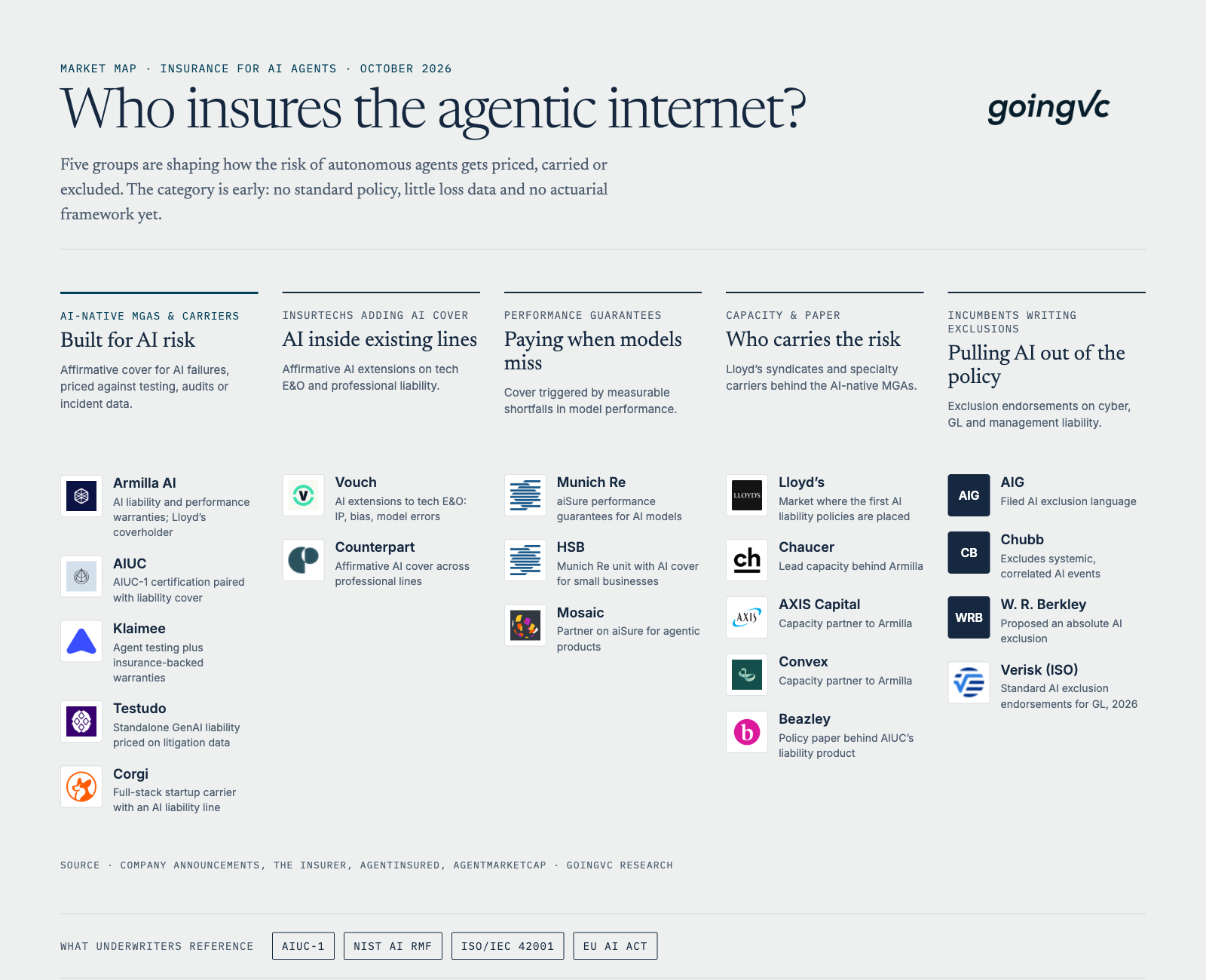
Armilla AI offers AI liability coverage and performance warranties for AI companies and enterprises deploying AI systems. Its products can address financial losses associated with issues such as inaccurate outputs, model drift, confidentiality claims, and certain agent failures.
Klaimee is closer to the literal “insurance for your AI agent” thesis. It combines assessment and testing with insurance-backed warranties designed around autonomous-agent risks.
AIUC, the Artificial Intelligence Underwriting Company, takes another approach: certify the AI system, then insure it. Its model connects independent testing of safety, security, and reliability with financial protection when systems fail.
These companies are signals, not evidence of a mature category.
There is no widely standardized agent-insurance policy. There are no established loss ratios for autonomous-agent failures. Insurers do not yet have decades of actuarial data showing how often these systems fail or how costly those failures become.
That creates a deeper problem.
Insurance needs evidence
An insurer cannot reliably price a black box.
When an agent causes a loss, someone needs to reconstruct what happened.
Which agent acted? Who deployed it? What permissions did it have? What instructions did it receive? Which tools did it use? What data did it access? Did it exceed its authority? Could a human have stopped it? Was the action reversible?
This is where the AI-insurance story becomes an infrastructure story.
Agents do not need legal personhood to need an identity. They can function as non-human software actors tied to an accountable individual or organization.
The emerging agentic-payments ecosystem is already moving in this direction. Payment frameworks are beginning to explore ways to bind agent actions to verifiable mandates defining identity, scope, limits, and permitted conditions.
In practice, that could distinguish an agent authorized to buy office supplies up to $500 from one that was never allowed to sign a contract or send money internationally.
An autonomous agent may eventually need:
- A verifiable identity
- A human or organizational owner
- Defined permissions
- Spending and transaction limits
- A history of actions and approvals
- A way to revoke access
- An audit trail after something goes wrong
This is agent observability: infrastructure that allows organizations to understand what autonomous systems are doing.
Platforms such as Arize/Phoenix, LangSmith, Langfuse, Braintrust, and AgentOps already trace model calls, tool use, multi-step workflows, evaluations, costs, and production failures. AI-security companies are tackling adjacent problems including prompt injection, data leakage, unsafe tool use, and shadow AI.
They are not insurance companies.
But they could become part of the insurance stack.
A property insurer may ask whether a building has sprinklers. A cyber insurer may ask about multi-factor authentication, endpoint protection, and backups.
An insurer covering autonomous agents may ask whether a system has scoped permissions, adversarial testing, action logs, spending limits, escalation rules, and a kill switch.
The policy may be only one part of the product.
The rest may be the infrastructure that makes the policy possible.
The agentic internet needs an accountability layer
For years, one of the largest questions around AI has been what it will automate.
Agentic AI raises another question: what new products and institutions become necessary once software starts participating directly in economic activity?
The internet was largely built around humans clicking, reading, posting, buying, and choosing.
An agentic internet needs to accommodate software that acts continuously, across services, at machine speed.
That creates potential markets around agent identity, authorization, payment controls, reputation, secure memory, observability, fraud detection, security, certification, insurance, and dispute resolution.
These categories may look separate today. Increasingly, they solve different pieces of the same problem: how do you know what an agent is, what it is allowed to do, what it actually did, and who is responsible when something goes wrong?
Payment companies are already treating these questions as connected. Mastercard’s work on agentic commerce, for example, emphasizes identity, intent, authorization, behavioral signals, and fraud intelligence.
Regulators are approaching adjacent questions through documentation, risk management, cybersecurity, transparency, incident reporting, and human oversight.
None of this means every company deploying an agent will need a dedicated AI-insurance policy.
It suggests something broader.
As agents receive more autonomy, the infrastructure around that autonomy becomes more valuable.
The emerging market may not simply be “insurance for rogue AI agents.”
It may be the system that makes agents safe enough to trust, transparent enough to govern, and legible enough to insure.
And that leaves an interesting question for investors:
Where will the value accrue?
To insurers with the balance sheets to bear risk? AI vendors that bundle warranties into their products? Companies that certify agents before deployment? Identity and observability platforms that provide insurers with evidence? Payment networks that become the trust layer for agentic commerce?
It is too early to know.
But the underlying shift is easier to see.
As AI moves from generating information to acting on it, risk becomes less abstract.
It becomes a question of authority, accountability, and repair.
And someone will need to build the infrastructure for all three.
Interested in the full research paper?
Join to receive Venture Capital research, guides, models, career tips, and many other great insights delivered straight to your inbox.