



Following the proceeds through debt, preferences, escrow, stock, and post-close terms.
A startup announces a $30 million acquisition.
That number may be the enterprise value of the business, the equity value paid to shareholders, or the maximum amount payable if future performance targets are met. It may include cash, buyer stock, deferred payments, or some combination of all three.
By the time debt is repaid, transaction expenses are paid, preferred shareholders receive any contractual priority, and part of the consideration is placed in escrow, the amount received by a common shareholder can look very different from the amount in the announcement.
The useful way to read an acquisition is to follow the proceeds in order: first into the company, then through the cap table, and finally into each shareholder’s accounts, sometimes immediately, sometimes later, and sometimes not at all. Let's hope that doesn't happen.
Start with the price definition
An acquisition price can refer to either enterprise value or equity value, and the difference affects how much shareholders receive.
Enterprise value is the value of the business before debt and cash are taken into account. Equity value is the amount attributable to shareholders after debt, cash, and other agreed adjustments are applied.
The first step is to determine what the $30 million represents.
If it is $30 million of enterprise value, it is the price for the operating business as a whole. If it is $30 million of equity value, it is the amount payable to shareholders, subject to any adjustments specified in the purchase agreement. The difference between enterprise value and equity value is generally the company’s net debt, along with other negotiated closing adjustments.
Assume the $30 million is enterprise value. The startup has:
- $4 million of debt
- $1 million of cash that is credited to the sellers
- $1 million of transaction expenses, such as banker and legal fees, paid from the sale proceeds
The amount available to shareholders would be:
$30 million−$4 million+$1 million−$1 million=$26 million$30 million−$4 million+$1 million−$1 million=$26 million
The debt reduces the amount payable to shareholders because it must be repaid or assumed as part of the transaction. The cash increases the amount payable to shareholders if the agreement treats it as cash retained for the sellers’ benefit. Transaction expenses reduce the proceeds because they are generally paid by the seller side.
Purchase agreements may also include a working-capital adjustment. The parties agree on the level of operating working capital the buyer expects the company to have at closing. This commonly includes receivables, inventory, accounts payable, and similar operating items.
If the company has less working capital at closing than the agreed target, the purchase price is reduced. If it has more, the purchase price may increase. Because the final accounting is often not complete on the closing date, the parties usually use an estimate at closing and make a later adjustment after the closing balance sheet is prepared.
The agreement should state:
- Which assets and liabilities count as working capital
- The accounting principles and calculation methods to be used
- The target amount
- The timeline for preparing and reviewing the post-closing calculation
- The process for resolving disputes
After these adjustments, the remaining amount is the pool of proceeds available for distribution. The next issue is how that pool is allocated among shareholders and other holders of company securities.
Then follow the cap table
After the purchase-price adjustments are complete, the next step is to determine how the available proceeds are distributed among the company’s security holders.
A shareholder who owns 25% of a company does not necessarily receive 25% of the sale proceeds. The result depends on the rights attached to each class of shares, especially preferred stock.
Investors in priced financing rounds often receive preferred shares with liquidation preferences. A liquidation preference gives the holder a contractual right to receive sale proceeds before common shareholders receive anything.
Assume an investor invested $10 million for 25% of the company and holds a 1x, non-participating liquidation preference. Assume that $30 million is available for distribution to shareholders.
The investor generally has two choices:
- Take the $10 million liquidation preference.
- Convert the preferred shares into common stock and receive 25% of the proceeds, or $7.5 million.
In this example, taking the preference produces the higher payment. The investor receives $10 million, and the remaining $20 million is available to common shareholders.
Although the investor owns 25% of the company on an as-converted basis, the investor receives one-third of the $30 million in proceeds. The difference results from the rights attached to the preferred shares.
A 1x liquidation preference allows the investor to receive an amount equal to the original investment before common shareholders participate. A non-participating preference requires the investor to choose either the preference payment or conversion to common stock. The investor does not receive both.
The analysis becomes more complex when a company has completed multiple financing rounds. Different classes of preferred stock may have different:
- Preference amounts, such as 1x, 1.5x, or 2x the original investment
- Priority levels relative to other preferred classes
- Conversion rights
- Rights to participate in remaining proceeds after receiving a preference
For example, participating preferred stock may allow an investor to receive its liquidation preference first and then share in the remaining proceeds with common shareholders. Whether that result applies depends on the company’s charter documents and the terms of the particular class of stock.
A distribution waterfall models these payments. It applies the rights of each security class in order and shows how the proceeds move through the capital structure before any remaining amount is distributed to common shareholders.
A cap table identifies who owns the company. A distribution waterfall shows what each holder may receive in a sale. Ownership percentage alone does not determine exit proceeds.
Not all proceeds arrive at closing
A distribution model may show the amount allocated to a shareholder, but not all of that amount may be paid at closing.
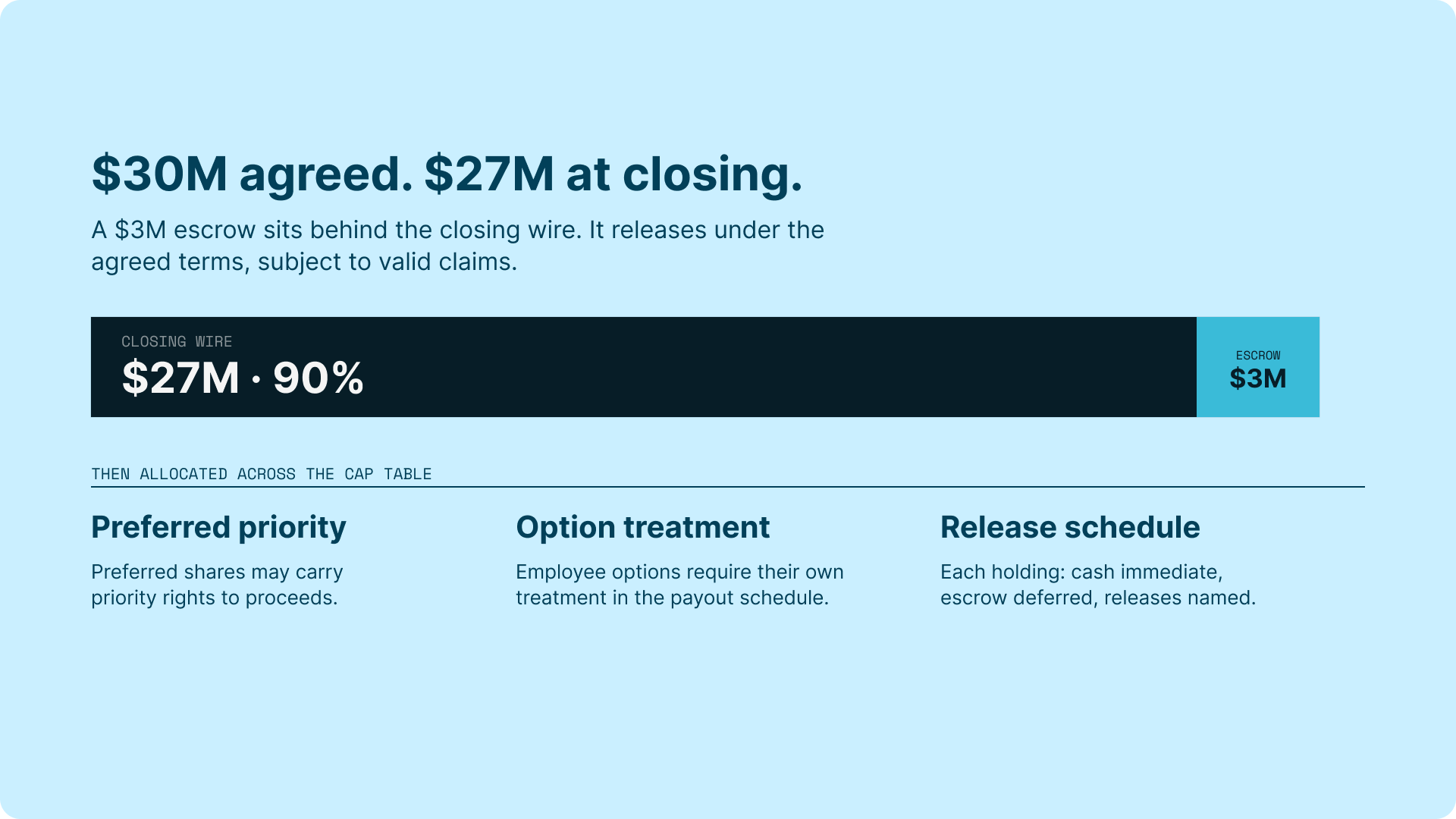
Assume the transaction provides for $30 million in cash consideration, with $3 million placed into escrow. Shareholders receive $27 million at closing. The remaining $3 million is held by an escrow agent for a stated period, often 12 to 18 months.
The escrow is available to cover certain claims by the buyer. These claims may arise from the sellers’ representations and warranties in the purchase agreement, including statements about the company’s intellectual property, financial records, customer contracts, taxes, liabilities, and other aspects of the business.
If the buyer identifies a covered issue, it may seek payment from the escrow. The purchase agreement determines:
- Which claims are covered
- The maximum amount available for claims
- The period in which claims may be made
- The process for reviewing and resolving disputed claims
A shareholder’s expected consideration therefore has two components:
- Cash paid at closing
- The shareholder’s portion of the escrow, reduced by any valid claims paid from it
For example, a shareholder allocated $5 million of total consideration may receive $4.5 million at closing and wait a year or longer for the remaining $500,000. The final amount received depends on whether claims are made and paid from the escrow.
A transaction can close while part of the consideration remains subject to post-closing claims and the escrow-release process.
Buyer stock is a new investment
A buyer may pay some or all of the acquisition price with its own shares rather than cash. In that case, the startup’s former shareholders become shareholders of the acquiring company.
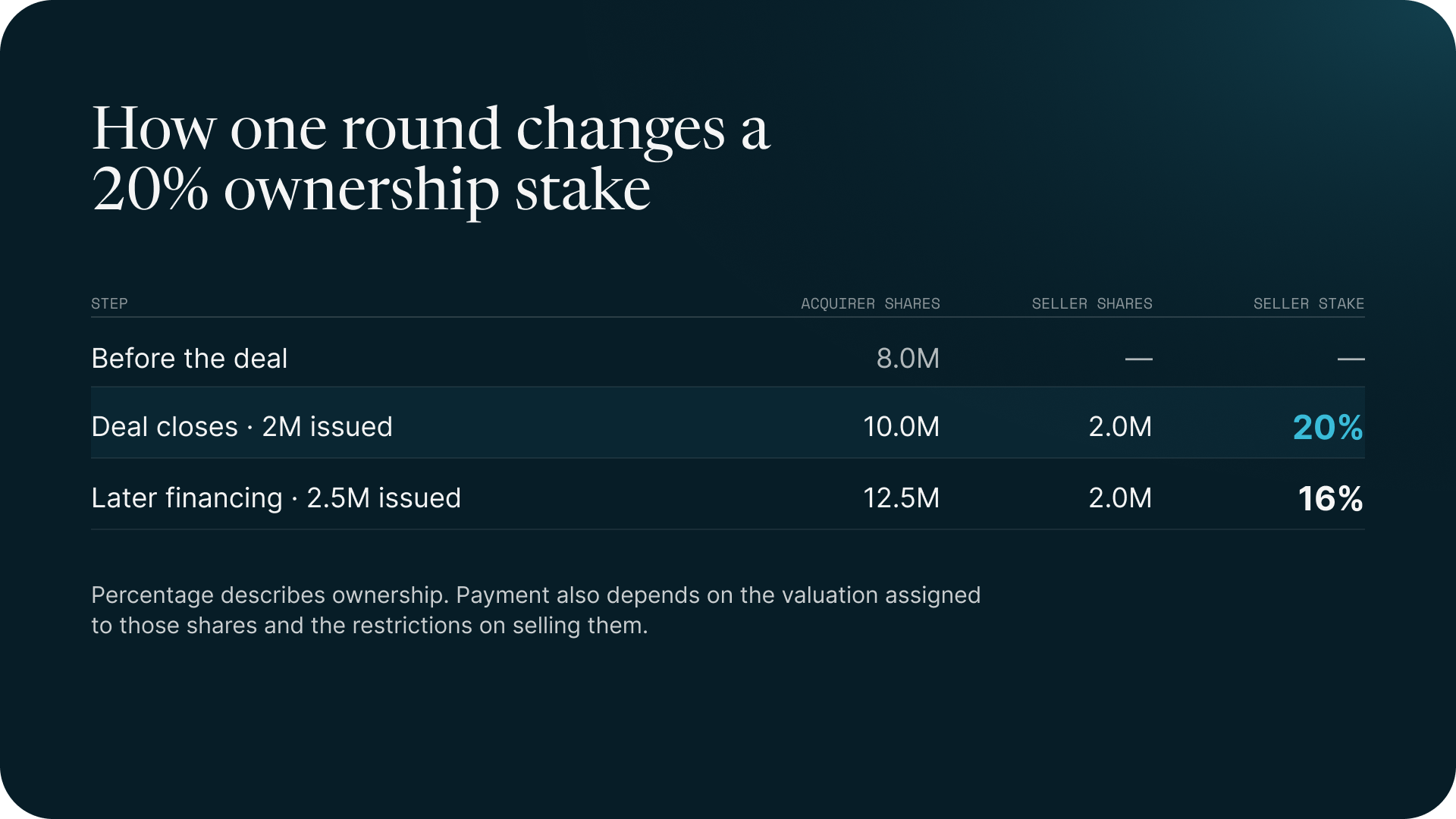
Assume the buyer has 8 million shares outstanding and issues 2 million new shares to acquire the startup. If the buyer has one class of shares and no other outstanding securities, the former startup shareholders collectively hold 2 million of the 10 million shares outstanding after the acquisition.
2 million / 10 million = 20%
The former startup shareholders therefore own 20% of the combined company immediately after the transaction.
That percentage may decline if the buyer later issues additional shares. For example, if the buyer issues 2.5 million new shares in a later financing round and the former startup shareholders do not participate, their ownership becomes:
2 million / 12.5 million=16%
The former startup shareholders still own 2 million shares. Their percentage declines because the total number of outstanding shares increases.
The value of buyer stock depends on more than the ownership percentage. Relevant factors include the buyer’s value, the class of shares received, the rights attached to those shares, and the ability to sell or transfer them.
A shareholder receiving buyer stock should review:
- Whether the shares are common stock or preferred stock
- Whether other classes have liquidation preferences or other distribution rights
- Whether the shares may be transferred or sold
- Whether the buyer is public or private
- Whether lockups, repurchase rights, voting agreements, or other restrictions apply
Public-company shares may be easier to sell, subject to applicable lockups, securities-law restrictions, and trading-window policies. Private-company shares may have a stated value but limited liquidity. A holder may not be able to sell them until an initial public offering, a later acquisition, a company-approved secondary transaction, or another permitted transfer.
Rollover equity keeps money in the deal
In some acquisitions, continuing ownership is not simply part of the buyer’s payment. It is a separate investment decision by the seller.
A founder may agree to reinvest part of the sale proceeds in the buyer or in a new holding company that will own the acquired business. This is commonly called rollover equity. It often appears in private-equity-backed transactions, particularly when the buyer wants the founder to remain invested in the business after closing.
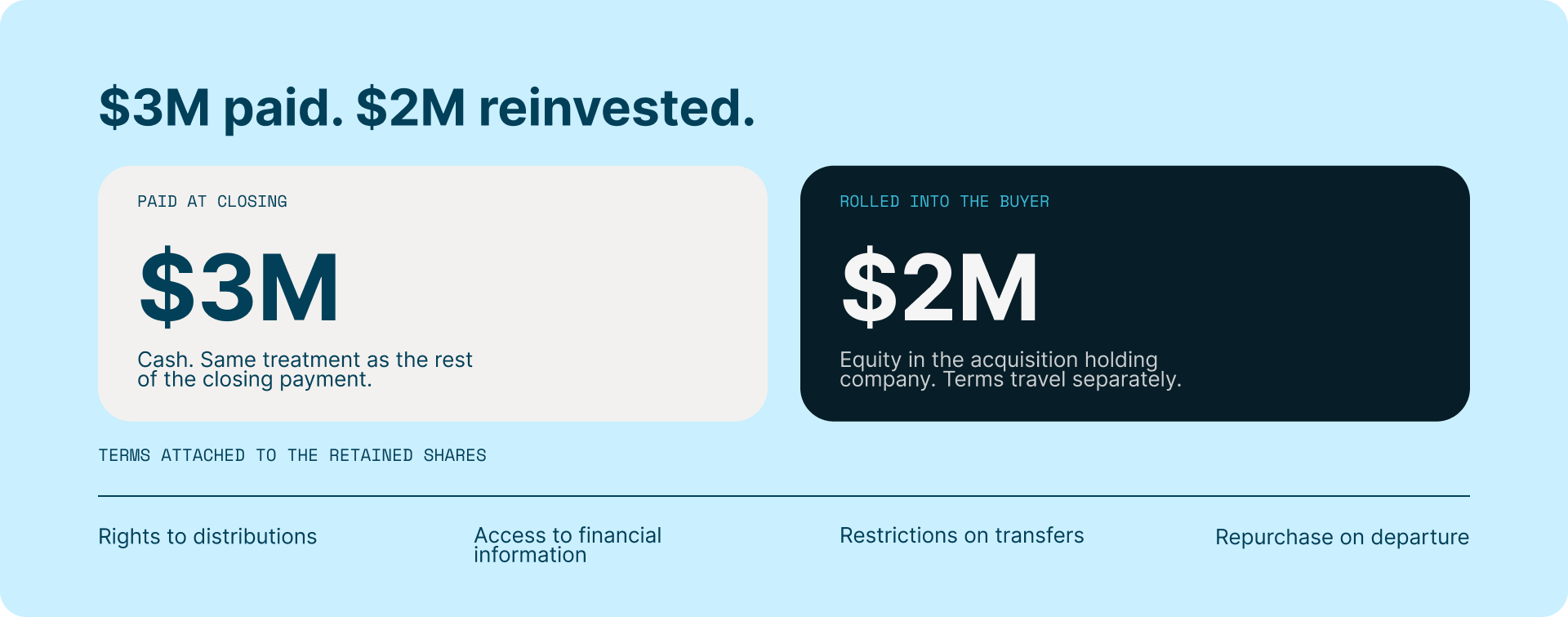
Assume a founder is allocated $5 million of sale proceeds and agrees to roll $2 million into the new ownership structure.
The founder receives:
- $3 million in cash at closing
- A $2 million investment in the new entity
The $2 million rollover investment is not equivalent to $2 million in cash. Its future value may increase, decrease, or remain difficult to realize for several years. The result depends on the performance of the business, the amount of debt in the new structure, the rights held by other investors, and the terms and timing of a later sale or other liquidity event.
Before agreeing to a rollover, the founder should review the terms as they would for any new investment:
- The entity issuing the rollover equity
- The class of equity the founder will receive
- The amount and priority of debt and preferred equity in the new structure
- Which holders receive distributions first in a future sale
- Whether the founder may transfer or sell the equity
- Whether the company may repurchase the equity if the founder leaves
- The price and conditions that apply to any repurchase right
- What happens to the rollover equity if the business is sold again
For example, a founder may roll $2 million into common equity while a private-equity sponsor holds preferred equity with priority distribution rights. In a later sale, the sponsor’s preference and any outstanding debt may be paid before the founder’s common equity receives proceeds. The founder’s ownership percentage, by itself, would not show that outcome.
A rollover may provide additional upside if the business grows and is later sold at a higher value. It also creates additional risk and may leave part of the founder’s economic return tied to an illiquid investment. It should be evaluated separately from the cash proceeds paid at closing.
Earnouts leave part of the price unresolved
An earnout makes part of the purchase price contingent on the acquired business meeting specified performance targets after closing.
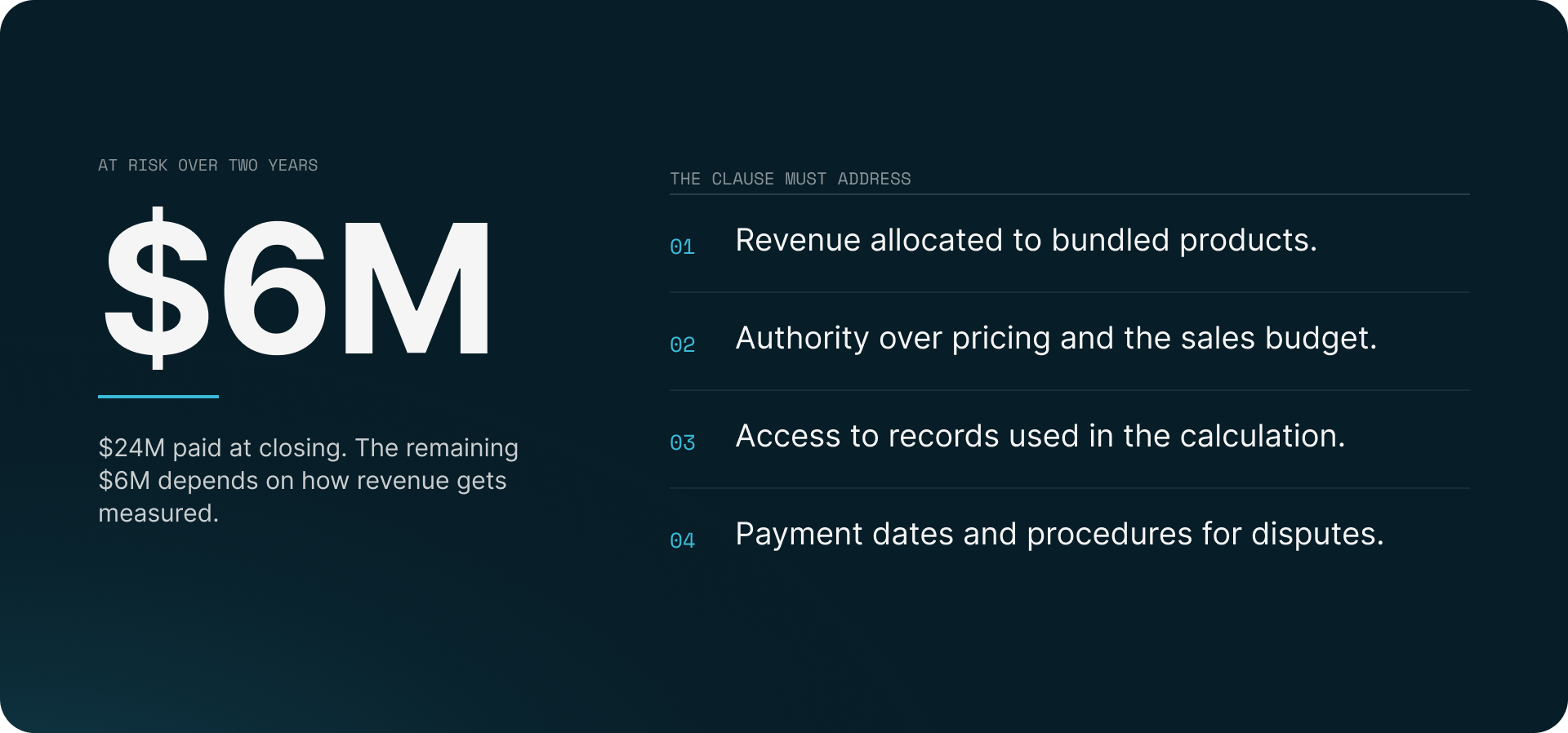
Assume a buyer pays $24 million at closing and agrees to pay another $6 million if the acquired business reaches a revenue target within two years. The transaction may be described as a $30 million acquisition, but only $24 million is paid at closing. The remaining $6 million depends on whether the earnout conditions are met.
The main issue is often not the target itself. It is how the parties measure performance after the startup becomes part of the buyer’s organization.
For example, suppose the buyer includes the acquired product in a broader subscription package. The package generates $20 million of revenue during the earnout period. The earnout agreement needs to specify how much of that revenue is attributed to the acquired product.
If the agreement attributes 40% of the package revenue to the acquired product, qualifying revenue is:
$20million} * 40% = $8million
If it attributes 60%, qualifying revenue is:
$20million} * 60% = $12million
If the earnout target is $12 million, the target is not met under the first approach and is met under the second. The revenue-allocation method changes the payment outcome.
Other post-closing decisions may also affect the earnout calculation. These can include:
- Changes to pricing or discount policies
- Changes to sales coverage, marketing, or customer-support resources
- Product-development priorities and spending
- Decisions to bundle, rename, replace, or discontinue the acquired product
- Internal reorganizations or changes in reporting structure
- Treatment of refunds, credits, cancellations, and customer churn
An earnout agreement generally needs to address:
- The precise metric being measured, such as revenue, bookings, EBITDA, or customer retention
- The accounting policies and calculation methods used
- The treatment of bundled products or services
- The treatment of discounts, refunds, credits, churn, and intercompany sales
- The buyer’s authority to operate the business, including decisions about pricing, hiring, and investment
- The seller’s access to relevant records and calculations
- The date and method for calculating and paying the earnout
- The process for resolving calculation disputes
An earnout can allow parties to proceed when they assign different values to the business at signing. It also leaves part of the consideration dependent on post-closing performance and on the methods used to measure that performance after the buyer takes control of the business.
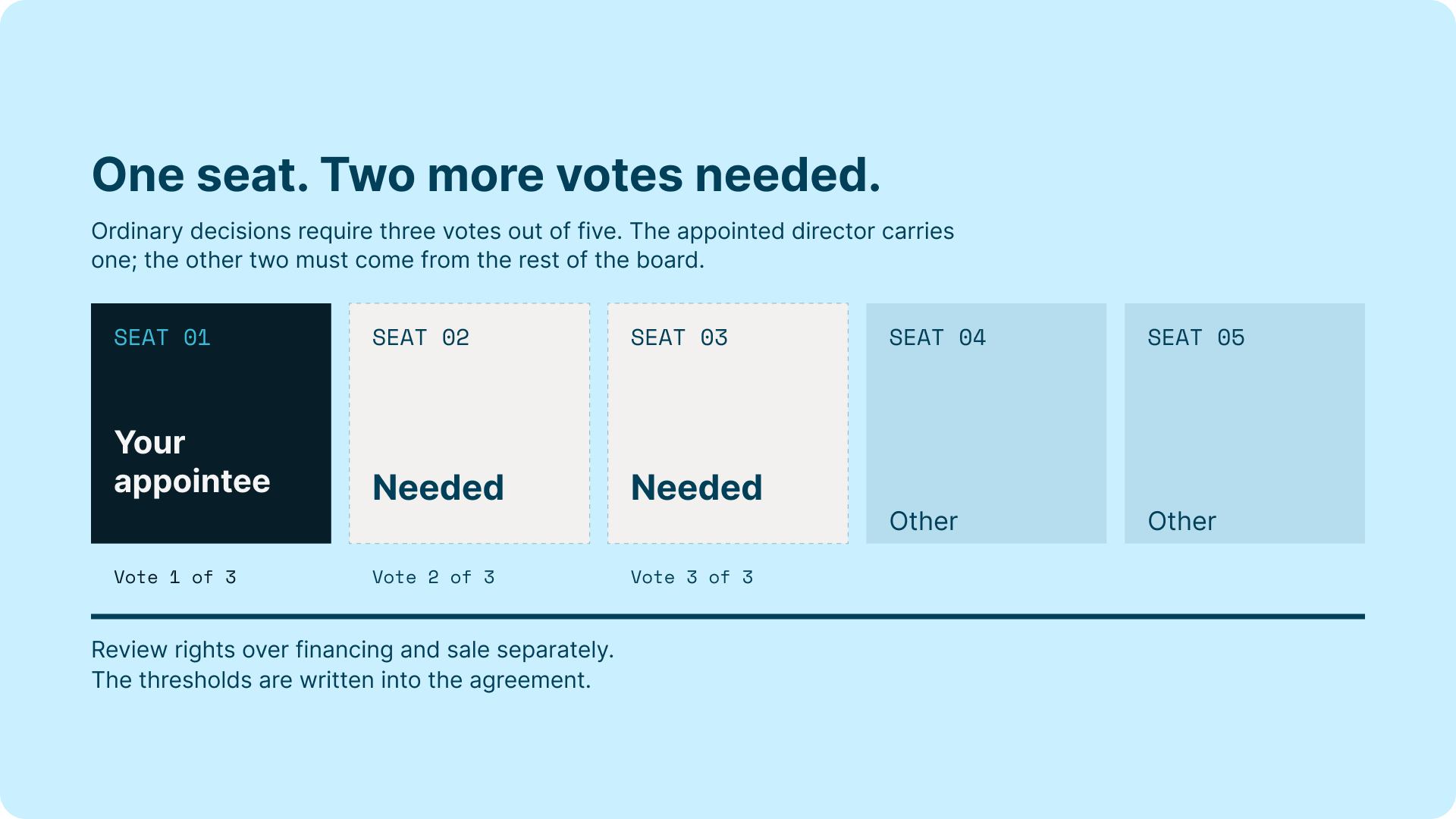
Board seats and decision rights
When founders or investors retain equity after a sale, ownership is only part of the arrangement. The other part is decision-making authority.
A board seat may provide access to information, participation in board discussions, and a vote on matters that come before the board. It does not necessarily give the holder control over company decisions.
Return to the example in which the sellers collectively own 20% of the buyer and appoint one director to a five-person board. If ordinary board decisions require a majority vote, three directors must approve an action. The sellers’ director can participate and vote, but cannot block a decision alone.
Consent rights operate differently. They require the approval of a specified shareholder, director, or class of shareholders before the company can take certain actions, even if the board otherwise approves the action.
Depending on the governing documents, consent rights may apply to actions such as:
- Issuing new shares or other securities
- Changing the rights of an existing class of shares
- Amending the company’s charter or other governing documents
- Incurring debt above an agreed threshold
- Completing a financing transaction
- Selling the company or substantially all of its assets
- Declaring distributions or changing the size of the board
A board seat and consent rights may exist together, but neither necessarily includes the other. The company’s charter, investor-rights agreement, voting agreement, shareholders’ agreement, and board rules determine the rights that apply.
A shareholder can own a significant minority stake and hold a board seat while having limited ability to prevent dilution, a later sale, additional debt, or changes to the company’s capital structure.
Price is only the beginning
Two buyers can offer the same $30 million headline price while proposing materially different transactions.
One buyer may offer most of the consideration in cash at closing. Another may offer less cash, a larger earnout, and shares in a private company. A third may ask the founder to reinvest part of the proceeds into a new holding company and offer a board seat without meaningful consent rights.
The headline price does not show how the consideration is allocated, when it is paid, or how certain it is. The transaction structure determines:
- The amount of cash paid at closing
- The amount subject to escrow, earnout conditions, or other post-closing adjustments
- Which security holders receive proceeds first
- The value and liquidity of any buyer or rollover equity
- The rights holders retain after closing
- The financial and operational exposure that remains after the sale
Evaluating an acquisition therefore requires more than comparing the stated purchase price. It requires following the proceeds through the purchase-price adjustments, the capitalization table, the distribution waterfall, and any continuing equity or contingent-payment terms.
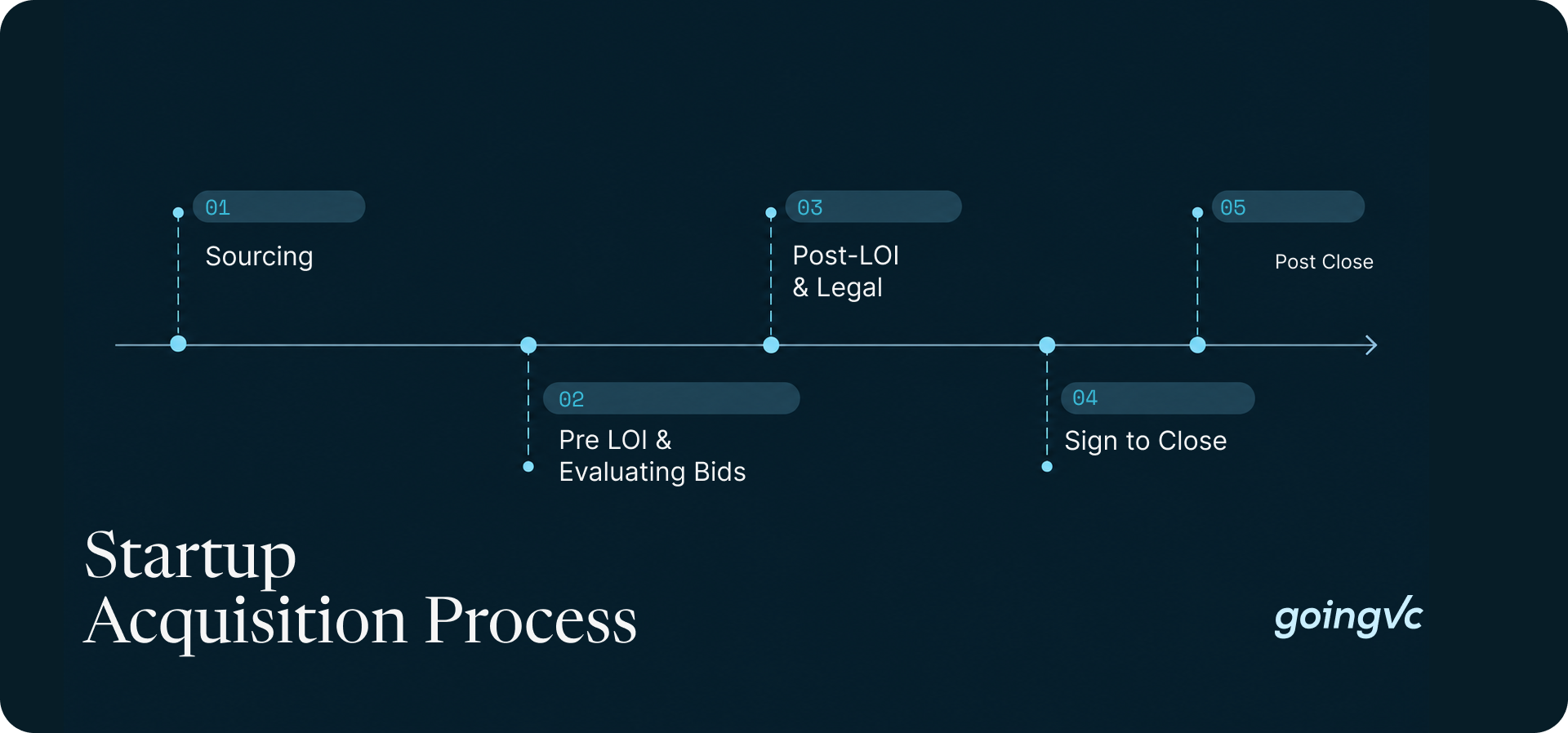
A useful acquisition analysis follows a simple sequence:
- Define the purchase price
- Adjust for debt, cash, expenses, and working capital
- Model the distribution waterfall
- Separate cash at closing from escrow and other deferred consideration
- Evaluate any buyer stock or rollover equity as a new investment
- Read the earnout terms as carefully as the upfront price
- Identify who retains decision rights after closing
The public announcement records a price. The distribution waterfall, escrow schedule, consideration mix, and governance terms determine the payout.
Hope this guides helps in your next acquisition.
This article is for educational purposes only and does not constitute legal, tax, or investment advice. Actual transaction outcomes depend on the company’s governing documents, capitalization, and negotiated purchase agreement.
Interested in the full research paper?
Join to receive Venture Capital research, guides, models, career tips, and many other great insights delivered straight to your inbox.


