


Adobe started in 1982 with a bet on the future of digital publishing. John Warnock and Chuck Geschke founded the company around PostScript, technology that helped computers and printers speak the same language and became part of the foundation for desktop publishing. Over the following decades came Illustrator, Photoshop, Acrobat, Premiere and the rest of a creative software empire.
If you worked anywhere near design, photography, publishing or video, Adobe was everywhere. Everybody and their mother knew Photoshop.
It was also expensive.
For much of its history, Adobe sold professional software through perpetual licenses. By 2012, Creative Suite 6 Design Standard cost $1,299 at full price. The complete Master Collection ran even higher. Adobe began moving customers toward Creative Cloud subscriptions around the same time, eventually making subscriptions the primary way to access new versions of its creative products.
And, much like music in the LimeWire era, plenty of people who could not or would not pay found other ways in. Cracked copies of Photoshop and Creative Suite circulated widely enough that software piracy became a meaningful business problem for Adobe. In 2008, Adobe estimated millions of additional creative professionals were using its products without paying.
Then, in 2012, Dylan Field and Evan Wallace started working on a very different idea.
What if professional design software lived on the internet?
Figma spent three years largely out of public view before launching its preview release in 2015 and opening to the public in 2016. Instead of downloading a heavy desktop program, designers could open a browser. Instead of sending files back and forth, teams could work from the same URL. And instead of design being an isolated activity, multiple people could eventually edit the same file at the same time.
That sounds obvious now. It was not obvious then.
Figma was betting that professional creative software could behave more like Google Docs. Browser based. Multiplayer. Always current. Built around teams rather than files sitting on one designer’s computer. Even people inside the design community initially questioned whether a browser could handle serious professional design work.
It arrived at a particularly good moment. Software was becoming increasingly visual. Startups were shipping websites and apps at an extraordinary pace. Designers, engineers and product managers needed to work together more closely, and interface design was becoming central to how technology companies built products.
Figma became part of the infrastructure for that shift. You could make a reasonable argument that it helped the UI and app boom move faster. I would.
Which makes what happened next much more interesting.
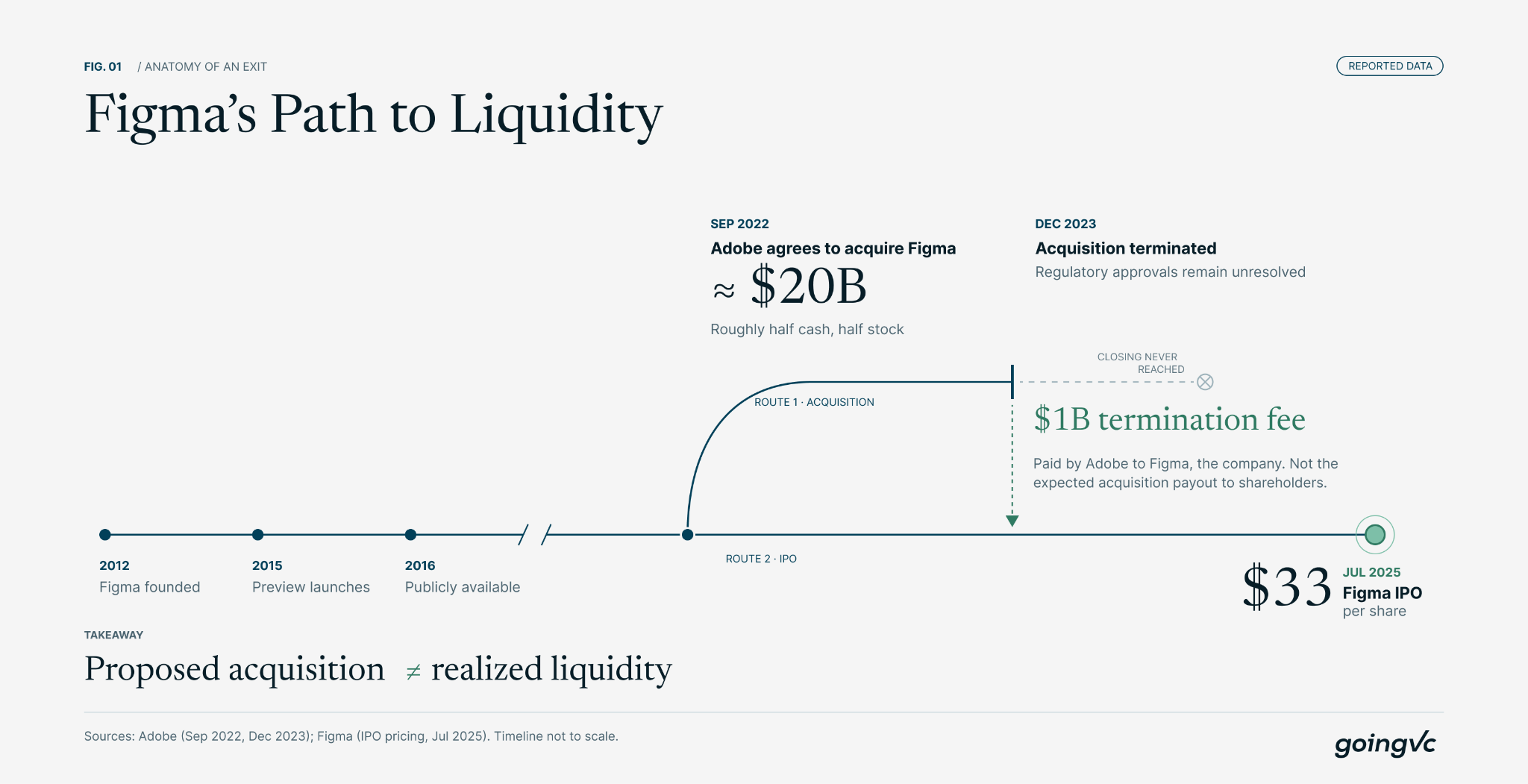
In September 2022, Adobe agreed to acquire Figma for approximately $20 billion, with consideration split roughly between cash and stock. For a company that had spent decades defining creative software, buying one of the most important new design platforms looked like a dramatic conclusion to the story.
Except it wasn’t.
Fifteen months later, Adobe and Figma abandoned the transaction after concluding they had no clear path to the necessary European and UK regulatory approvals. The expected acquisition proceeds never reached Figma’s shareholders. Adobe instead paid Figma a $1 billion termination fee. That money went to the company, not to shareholders as the acquisition payout they had expected.
Then the story changed again.
By July 2025, Figma had taken a completely different route to liquidity, pricing its IPO at $33 per share. The offering included shares sold by Figma itself and shares sold by existing stockholders, meaning the money did not all go to the same place.
For an investor in Figma, the expected exit had gone from a $20 billion acquisition, to no acquisition at all, to an IPO almost three years later.
That sequence makes Figma unusually useful for understanding what an exit actually is.
Because an exit is not the headline saying a company was “acquired for $20 billion.” It is the process that determines whether shareholders can turn their ownership into liquidity, how much they actually receive, and when they receive it.
For someone learning venture capital, that leads to the question at the center of exit analysis:
How much money can this investment return, to whom, and when?
An exit happens at the shareholder level
Investors can sell their holdings through an acquisition, an IPO that includes shares from existing holders, or a secondary transaction in a private company. Each route can produce a full or partial exit. A company can remain independent while an investor sells its entire stake; an acquisition can leave sellers holding shares in the buyer.
An IPO deserves particular care. When a company issues new shares, it receives the proceeds. When existing shareholders sell shares, those sellers receive the proceeds. Investors who retain their shares continue to bear price risk and may face resale restrictions or contractual lockups. The SEC notes that IPO lockups typically last 180 days, although the actual terms vary. [6]
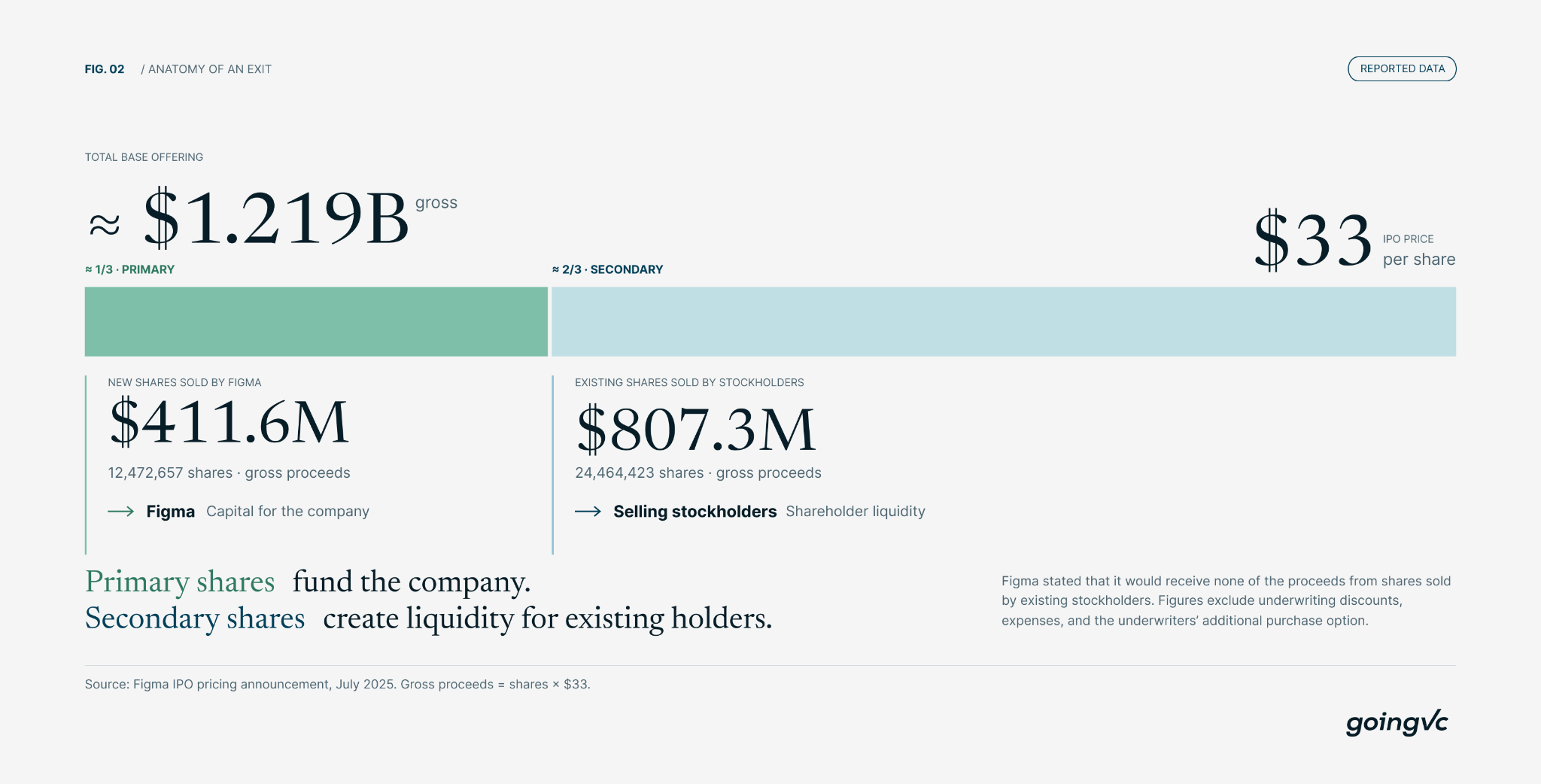
Figma’s 2025 IPO pricing announcement makes the distinction tangible. At $33 per share, the base offering comprised:
- 12,472,657 shares offered by Figma: approximately $411.6 million gross.
- 24,464,423 shares offered by existing stockholders: approximately $807.3 million gross.
Together, that was approximately $1.219 billion before underwriting discounts and expenses, excluding the underwriters’ additional purchase option. Figma specified that it would receive none of the proceeds from the selling stockholders’ shares. These figures describe the base offering at pricing, rather than every investor’s eventual realized return. [7]
That split is worth looking for whenever an IPO headline says a company “raised” a particular amount. The offering can fund the business and provide shareholder liquidity at the same time.
Getting from an offer to a closing
An acquisition process gives a buyer time to test the business it wants to buy and gives sellers a chance to negotiate how they will get paid.
The parties may begin with a letter of intent covering price, payment structure, timing and major conditions. Much of an LOI may be nonbinding, while provisions such as confidentiality and exclusivity can bind the parties. Exclusivity can restrict the seller’s ability to pursue other buyers during negotiations. [8]
That creates a practical decision for the board: how long can the company afford to negotiate with one buyer? A company with limited cash may lose bargaining power as the process consumes its remaining runway. Before granting exclusivity, the board should understand the buyer’s funding, approval process and proposed timetable.
During diligence, the buyer examines the financials, customer contracts, intellectual property, employee arrangements and ownership records. Problems can change the price or terms. A missing IP assignment, for example, creates a different risk from a customer contract that requires consent before a change of control. The team needs to identify who can resolve each issue and whether it must do so before closing. [8]
Signing the definitive agreement creates contractual obligations, but a transaction with outstanding closing conditions still has work ahead. The parties may need regulatory clearance, shareholder approval or third-party consents. Adobe and Figma reached this stage and still did not complete their acquisition.
AppDynamics offers a completed-deal comparison. It was preparing for an IPO when Cisco announced an acquisition agreement in January 2017. Cisco closed the purchase that March for approximately $3.7 billion in cash and assumed equity awards. Its SEC filing and Cisco’s announcements let an investor trace the change in route and distinguish the agreement from completion. They do not disclose every shareholder’s net payout. [1–3]
For an investor, a useful exit memo separates the proposed price from the evidence that the buyer can complete the purchase. It also explains what happens if the process fails: whether the company has enough cash to continue, whether another buyer remains interested, and whether it needs new financing.
Follow one acquisition through the numbers
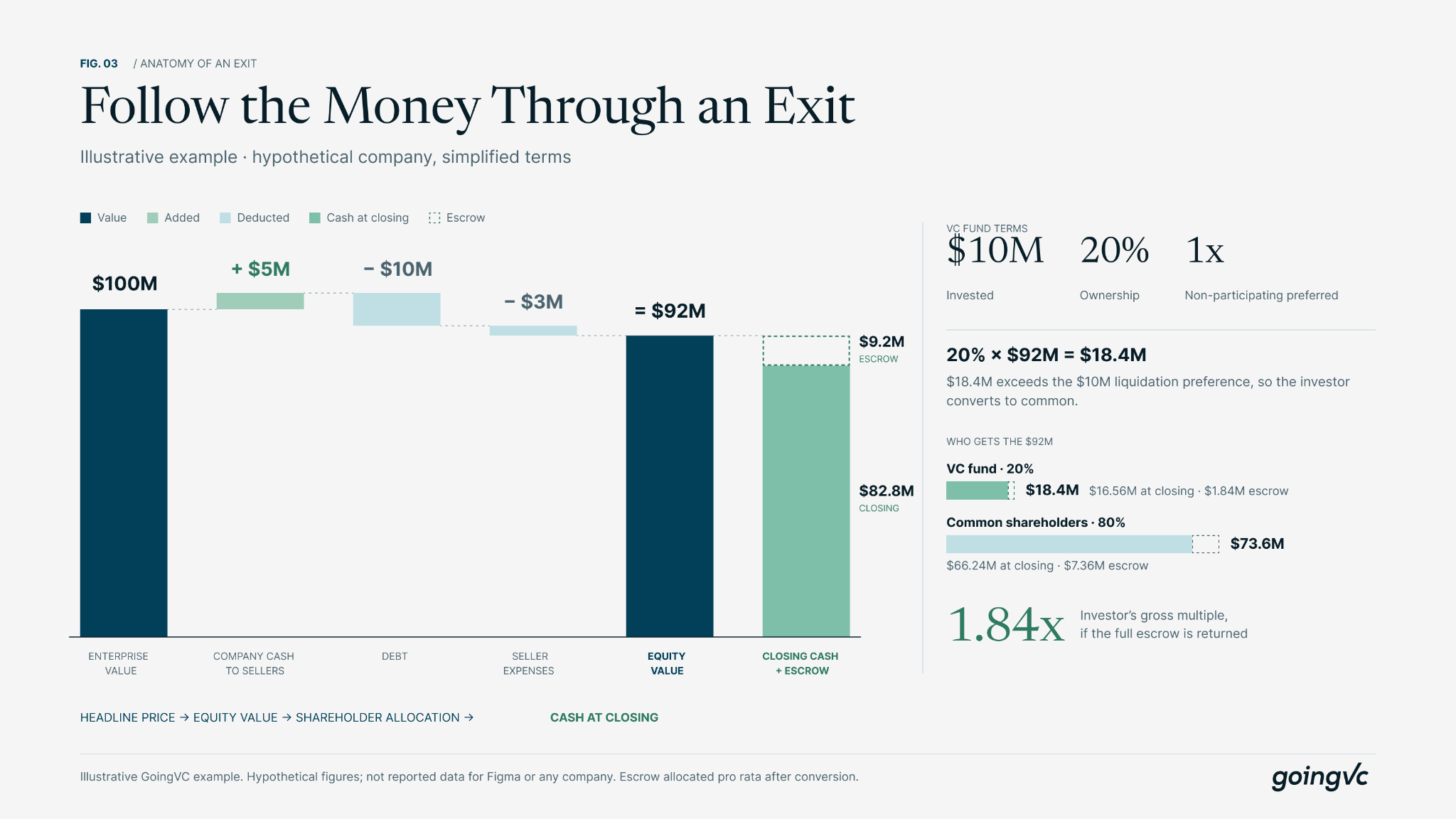
Consider a hypothetical startup sale. The following figures are illustrative, with simplified terms chosen to make the calculation visible.
The buyer offers $100 million of enterprise value, meaning the value of the operating business before the agreed debt and cash adjustments. Assume the agreement credits $5 million of company cash to sellers, deducts $10 million of debt and $3 million of seller transaction expenses, and requires no working-capital adjustment.
$100m enterprise value + $5m cash − $10m debt − $3m expenses = $92m available to equity holders.
The agreement also places $9.2 million of that amount in escrow to cover eligible claims. Shareholders receive $82.8 million at closing and may receive the remaining $9.2 million later. Escrow forms part of the $92 million allocation; it is not an additional deduction from the total deal value in this example.
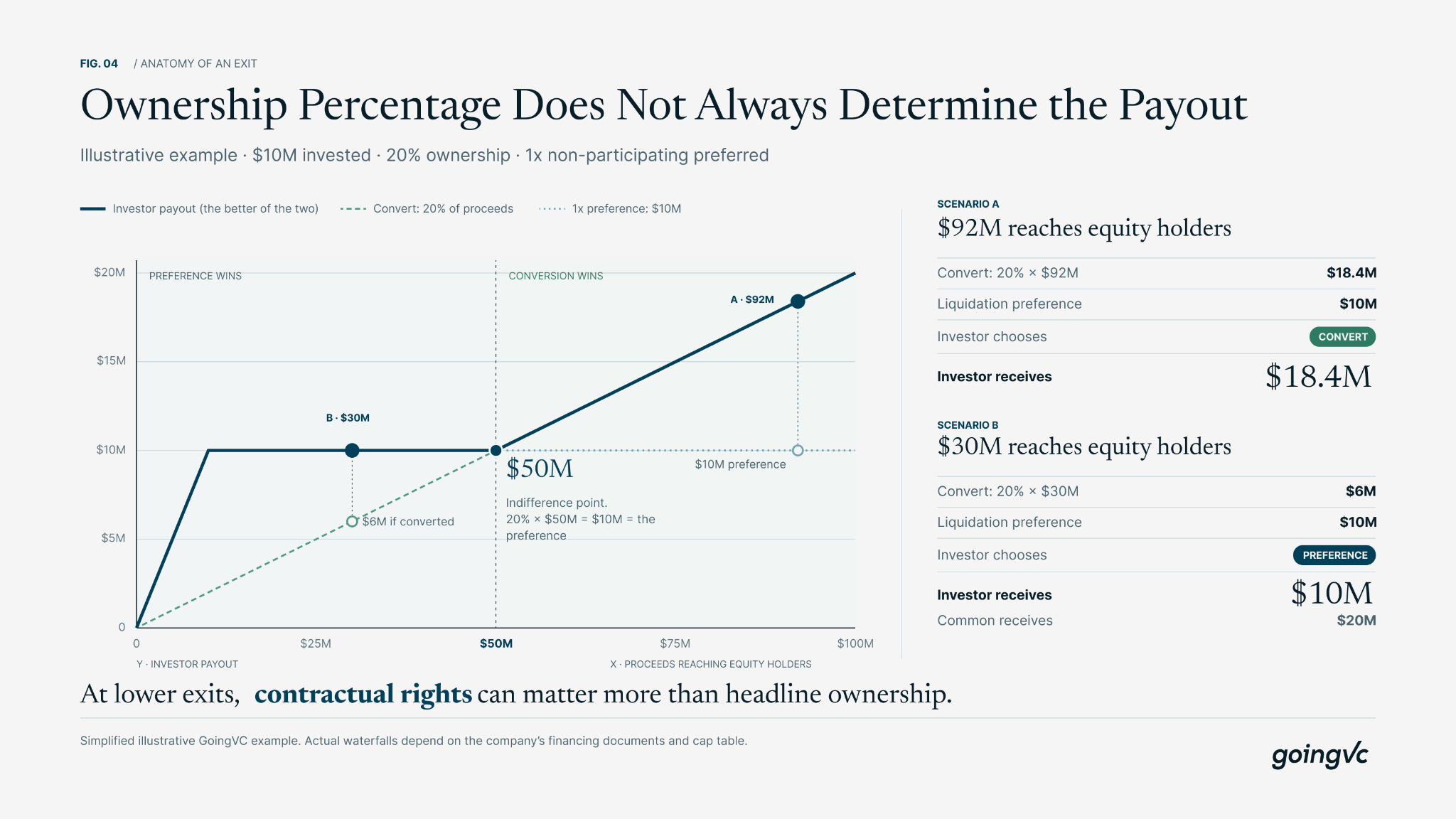
Now consider the cap table. A VC fund invested $10 million and owns 20% on an as-converted basis, meaning its ownership if its preferred shares converted into common shares. Assume it holds the only preferred class, with a 1x non-participating liquidation preference, and that the remaining 80% belongs to common shareholders.
The investor compares its $10 million preference with the $18.4 million it would receive by converting and taking 20% of the $92 million. It chooses conversion. Non-participating preferred generally requires that choice between the preference and the common-equivalent payout. [9]
Assuming the agreement allocates escrow proportionately after that conversion:
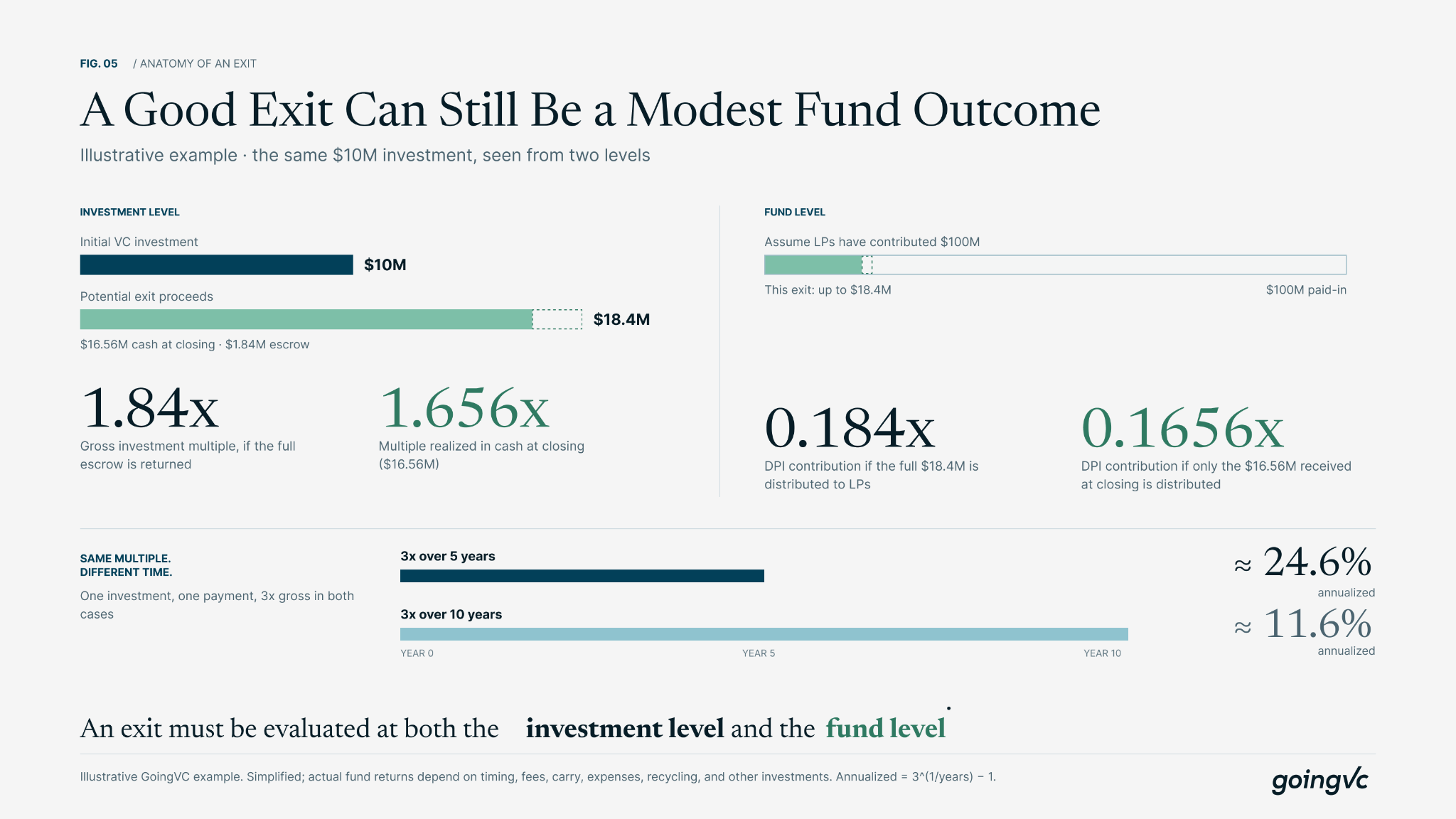
- The fund receives $16.56 million at closing and has $1.84 million allocated to escrow.
- Common shareholders receive $66.24 million at closing and have $7.36 million allocated to escrow.
The fund’s total proceeds reach $18.4 million only if the full escrow allocation comes back. Against a $10 million investment, that would be a 1.84x gross multiple. At closing, the fund has received 1.656x its invested capital in cash. Both figures exclude fund-level fees, carried interest and taxes.
Change the sale outcome and the allocation changes. If just $30 million reaches equity holders under the same simplified cap table, conversion would give the fund $6 million. The fund instead takes its $10 million preference, leaving $20 million for common. Its 20% ownership now produces one-third of the proceeds. With several preferred classes, participation rights or different seniority, the calculation requires a class-by-class distribution waterfall.
The money that still depends on something
A payout schedule should distinguish cash delivered at closing from escrow, earnouts and buyer shares.
Escrow delays an allocated payment and exposes it to specified claims. An earnout makes an additional payment conditional on future performance. Buyer shares give the seller an investment whose eventual cash value depends on the share price, rights and ability to sell. [12]
Those distinctions matter when comparing offers. Suppose one buyer offers $90 million in cash at closing and another offers $80 million at closing plus a $30 million earnout. For this separate hypothetical, assume identical debt, fees, taxes and closing risks. The second offer produces more nominal cash only if the earnout pays more than $10 million. Timing and uncertainty make the decision more demanding than comparing $90 million with a $110 million maximum.
To assess that earnout, an investor needs the performance formula and the operating assumptions behind it. A revenue target means little without knowing how the buyer will allocate sales from bundled products, who will control pricing, and whether sellers can inspect the calculation. A probability estimate should come from those facts rather than an arbitrary percentage applied to the maximum payout.
The buyer’s retention payments to employees also deserve a separate line. Compensation for continuing to work can benefit particular employees without increasing the acquisition proceeds available to shareholders generally. Combining the two can overstate the return attached to an investor’s shares.
A good company outcome can make a modest fund contribution
Return to the fund receiving up to $18.4 million from the hypothetical acquisition. Suppose its investors, known as limited partners or LPs, have paid $100 million into the fund.
If the fund distributed the entire $18.4 million to those LPs, the exit would contribute 0.184x to distributions to paid-in capital, or DPI. At closing, distributing the $16.56 million received would contribute 0.1656x. These are simplified contributions from this investment, assuming no deductions or retained proceeds and a constant paid-in-capital denominator. Actual LP distributions depend on the fund agreement, expenses, carried interest and any permitted recycling of proceeds. [10]
DPI measures cumulative distributions divided by paid-in capital. An acquisition announcement does not enter the numerator, and proceeds sitting in the fund have not yet reached its LPs. Fund reporting can also include distributions of securities in kind, which should be distinguished from cash distributions. [10, 13]
Time adds another dimension. In a separate illustration with one initial investment and one final payment, a 3x return over five years implies about a 24.6% annualized return. The same 3x over ten years implies about 11.6%. Actual fund IRR incorporates the dates of all contributions and distributions.
This is why an investor can welcome a sale and still ask whether holding longer would improve the fund’s outcome. The decision depends on the proceeds, the remaining risks, the likely timing of another opportunity and the fund’s obligations to its investors.
Reading the next exit announcement
Start by identifying the transaction’s status: proposed, signed or closed. Then establish what the quoted price includes, how the cap table allocates it, and how much each investor can receive at closing. Follow the remaining payments through their conditions and dates, then calculate the investment return and the contribution to the fund.
AppDynamics provides a completed acquisition to study. Figma provides a failed acquisition followed by a different liquidity route. Neither public headline reveals every shareholder’s return. The useful analysis begins with the disclosed terms and stays explicit about the numbers that remain unknown.
Interested in the full research paper?
Join to receive Venture Capital research, guides, models, career tips, and many other great insights delivered straight to your inbox.


