If you want to build a career in venture capital, the first question is not always which fund you want to join. It is which side of the table fits the way you want to invest, learn, and build.
Traditional venture capital and corporate venture capital share the same vocabulary: deals, diligence, portfolios, founders, investment committees, and returns. The day to day can look remarkably similar from the outside.
The mandate underneath the desk tells a different story.
A traditional VC fund invests capital on behalf of limited partners and builds a portfolio designed to generate financial returns. A corporate venture capital team invests from inside a company, often with financial returns sitting alongside strategic objectives such as accessing new technologies, entering emerging markets, developing partnerships, or gaining insight into where an industry is moving.
The distinction matters for anyone considering a career in venture.
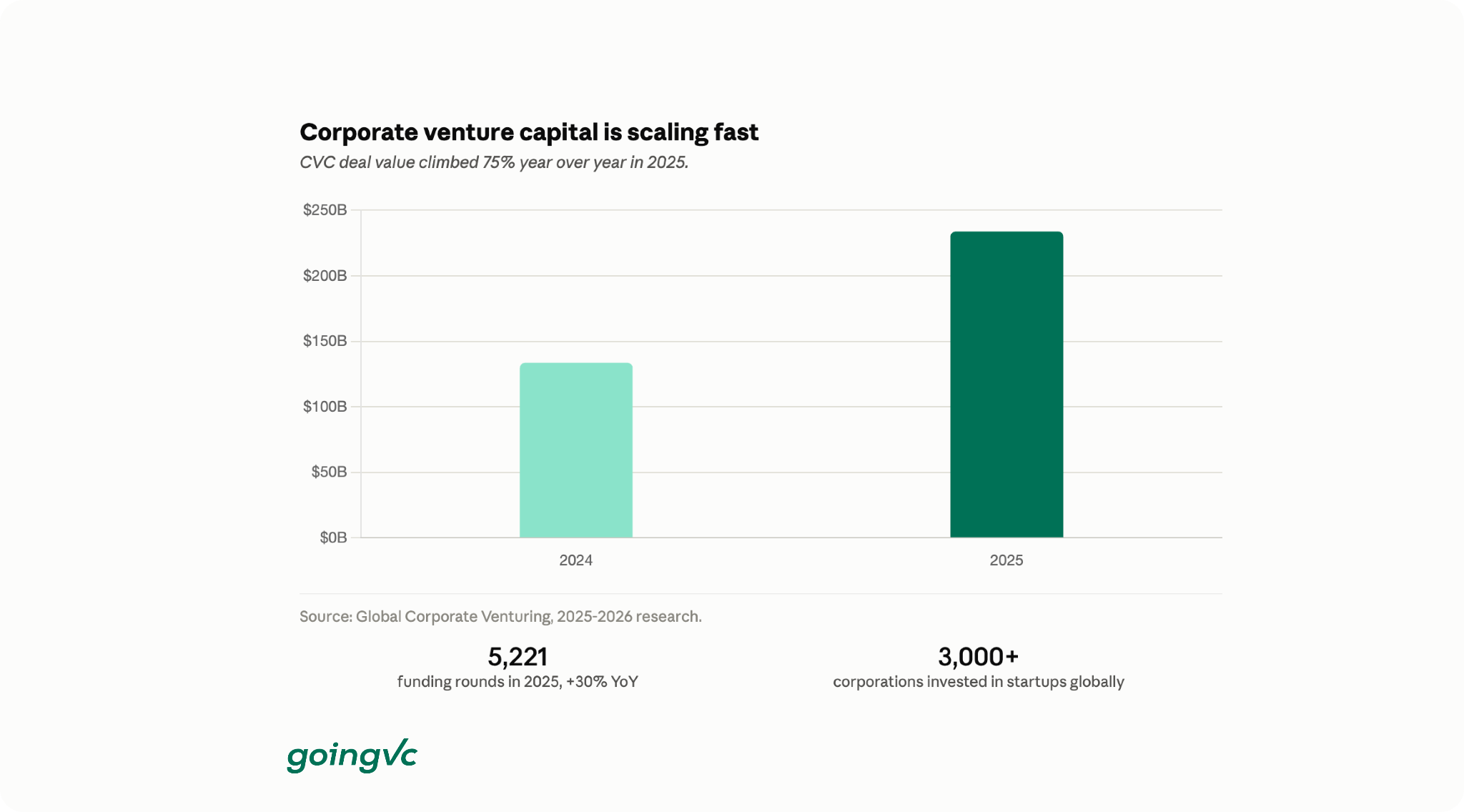
And CVC is becoming harder to overlook. In 2025, more than 3,000 corporations invested in startups globally. Corporate investors participated in 5,221 startup funding rounds, a 30% increase from 2024, while the value of those deals climbed 75% to $233.8 billion. (Global Venturing)
The question is no longer whether CVC belongs in the venture ecosystem. It is whether its particular seat belongs in your career plan.
Start with the mandate
The simplest way to understand the difference is to look at what each investor is trying to accomplish.
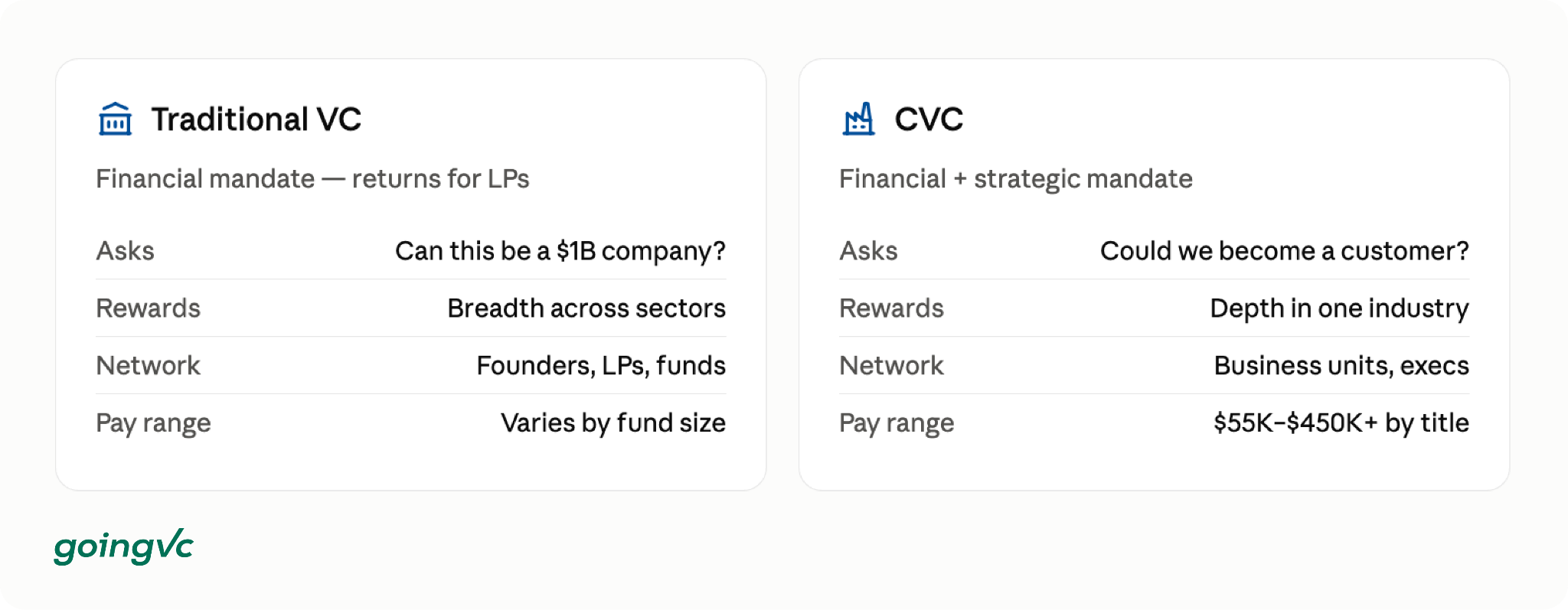
A traditional VC fund has a financial mandate. The investment team looks for companies that can generate attractive returns for the fund and, ultimately, its limited partners. That means assessing markets, founders, business models, competitive dynamics, valuations, ownership, dilution, follow-on requirements, and potential exits.
A CVC team has another layer to consider.
The investment may need to make financial sense, but the corporation may also care about what sits around the investment. Can the startup become a supplier? Can it become a customer? Can its technology accelerate an internal product? Can the relationship provide access to a market the corporation has not entered? Can the team learn something about where the industry is heading?
That additional lens changes the investment conversation.
Global Corporate Venturing’s 2026 research found that 52% of corporate investment teams target at least VC-level financial returns. At the same time, 43% of corporate investors said they will develop a commercial relationship with more than half of the startups they invest in. (Global Venturing)
The check therefore represents more than capital.
It can represent a partnership, a market signal, a commercial relationship, or a window into an emerging technology.
The work looks similar. The questions change.
An associate at a traditional VC fund might spend the morning reviewing a pitch deck, researching a market, speaking with founders, building an investment case, and preparing an investment committee memo.
A CVC associate can do much of the same work.
The difference emerges in the questions that follow.
A traditional VC might ask:
Can this become a $1 billion company?
How large can the market become?
What does the competitive landscape look like?
What ownership can we achieve?
What valuation makes sense?
What could the exit look like?
A CVC team can ask all of those questions and then add another layer:
How could this company affect our core business?
Could we become a customer?
Could we distribute its product?
Could its technology strengthen our existing capabilities?
Does this investment give us visibility into a market we need to understand?
That means CVC often rewards people who can connect the startup ecosystem to the corporate ecosystem.
The investment memo still matters. So does the market map. So does the founder meeting.
But the corporate strategy deck can enter the room too.
Traditional VC may suit you if you want breadth
Traditional VC can offer exposure across companies, sectors, business models, and stages.
That breadth can be especially valuable early in a career.
One week might involve a fintech company. The next could bring a developer tools business, a climate startup, or an enterprise software company. Over time, that repetition builds pattern recognition.
You begin to recognize what a strong founder looks like.
You learn how markets form.
You see how distribution can become a moat.
You understand why some companies raise capital easily while others struggle.
You watch portfolio companies move through funding rounds, pivots, acquisitions, and exits.
The venture market itself has also become increasingly concentrated around large rounds and AI. In 2025, U.S. VC firms closed 15,352 deals worth $320 billion, with AI accounting for 65.4% of total deal value. (NVCA)
That environment makes breadth even more valuable. The ability to understand a technology, identify its commercial implications, and compare it against adjacent markets has become a core part of the investor’s toolkit.
Traditional VC is particularly attractive if you enjoy moving between industries and want your investment lens to remain relatively independent of one operating company.
CVC may suit you if you want depth
CVC offers a different kind of proximity.
Instead of looking at an industry from the outside, you can sit inside one of its largest participants.
That creates access that a traditional fund may not have.
A corporate investor can understand how a technology affects procurement, distribution, regulation, customers, operations, and product development from the inside. The corporate platform can also give a portfolio company access to commercial relationships that extend beyond the cap table.
Global Corporate Venturing found that 95% of corporate investors target early-stage Series A and Series B companies, while 52% also look at seed and pre-seed. (Global Venturing)
This makes the CVC seat particularly interesting for people who enjoy combining investing with industry knowledge.
If your curiosity naturally moves from “Is this a good company?” to “How will this technology change our industry?”, CVC can offer a strong fit.
Your background can point you toward one seat
Your previous experience also matters.
Traditional VC teams often value experience in investing, banking, consulting, entrepreneurship, product, technology, or another sector that provides a useful sourcing or analytical advantage.
CVC can draw from an even wider pool.
Corporate development, strategy, product, innovation, business development, engineering, finance, and industry-specific operating roles can all create relevant experience.
The reason is simple.
CVC needs people who understand both sides of the table.
A financial analyst can understand the economics of an investment. A product leader can understand the technology. A strategy professional can understand the strategic implications. A strong CVC investor learns to connect all three.
That makes CVC an especially interesting route for professionals who already sit close to strategy or innovation but want to move toward investing.
The career experience can feel different
The biggest difference may not appear in the investment process. It can appear in the organization around it.
Traditional VC puts you inside an investment firm.
Your closest colleagues are likely investors. Your calendar revolves around founders, other funds, portfolio companies, limited partners, conferences, and the broader startup ecosystem.
CVC puts you inside a corporation.
Your network can extend across investors and founders, but also across business units, product teams, strategy teams, executives, customers, and corporate development.
That can create a broader operating context.
It can also create a different pace.
A traditional VC partnership may make investment decisions within a relatively focused investment structure. A corporate investment can sometimes involve additional stakeholders because the investment may affect business units beyond the investment team.
Neither structure is inherently better.
They reward different forms of patience.
Compensation is only one piece of the equation
Compensation should enter the career decision, but it should not make the decision alone.
CVC compensation varies significantly by title, geography, sector, and corporate structure. Global Corporate Venturing’s 2025 benchmarking found that CVC investment analysts earned roughly $55,000 to $105,000, while senior directors and managing partners could earn more than $300,000. The highest quartile of CVC unit heads reached approximately $450,000 in base salary, before potential bonuses and other incentives. (Global Venturing)
Traditional VC compensation also varies widely by fund size, geography, seniority, and economics.
The more useful question is what you are optimizing for.
Are you optimizing for exposure to many markets?
Do you want to build deep expertise in one industry?
Do you want to work closely with founders?
Do you want proximity to corporate strategy?
Do you want to develop an investing career?
Do you eventually want to operate a company?
The right seat depends on the answer.
CVC is no longer a niche corner of venture
The growth of CVC makes this choice increasingly relevant.
Global CVC investment reached $286.9 billion in 2025, according to KPMG, making it the second-highest annual level on record. The increase was driven heavily by U.S. investment in AI and AI infrastructure. (KPMG Assets)
PitchBook and NVCA data also show how important corporate investors have become within the broader venture market. In Q1 2025, CVC participation reached a record share of VC deal value, according to the PitchBook-NVCA Venture Monitor. (NVCA)
The corporate check has become a significant part of the venture market.
That creates more seats.
It also creates more specialized seats.
Financial services companies can build fintech portfolios. Healthcare companies can invest around biotech and digital health. Industrial companies can build relationships with climate and manufacturing startups. Technology companies can invest around infrastructure, software, and AI.
The corporate logo can therefore tell you something about the investment thesis before you even open the deck.
So, which path is right for you?
Think about the kind of investor you want to become.
Choose traditional VC if you want to:
Build broad exposure across industries
Work primarily around financial returns
Develop a career centered on investing
Spend significant time sourcing and evaluating startups
Build a wide founder and investor network
Develop pattern recognition across different markets
Choose CVC if you want to:
Combine investing with corporate strategy
Develop deep expertise in a specific industry
Work across startups and established businesses
Understand how emerging technologies affect an industry
Build commercial relationships alongside investments
Use an operating, strategy, product, or industry background as an investing advantage
There is also a third answer.
You do not have to choose one forever.
Careers in venture can move between the seats. An investor can move from CVC to traditional VC. A strategy professional can move into CVC. An operator can move into venture. A traditional VC can move into an operating role and eventually return to investing.
The important thing is to understand what each seat teaches you.
Traditional VC can teach you how to evaluate businesses across markets.
CVC can teach you how capital, technology, and corporate strategy intersect.
Both can teach you how to recognize where the market is going before the market has fully arrived.
The best career path is the one that matches your lens
Venture is ultimately a business built around judgment.
The title matters less than the lens you develop.
A traditional VC investor learns to look across the market and identify where capital can create the strongest financial outcome.
A CVC investor learns to look through the market and identify where technology, capital, and corporate capability can create an advantage.
Both seats require curiosity.
Both require analytical discipline.
Both require strong networks.
Both require the ability to understand a founder before the spreadsheet tells the whole story.
The difference is where you place the lens.
If you want to see across industries, traditional VC may be the stronger fit.
If you want to see deeply into one industry while sitting at the intersection of capital and corporate strategy, CVC may offer the better seat.
And if you are still deciding, start with the question that matters most:
What do you want to learn from the companies you invest in?
Your answer may tell you which side of the table belongs in your next chapter.
Interested in the full research paper?
Join to receive Venture Capital research, guides, models, career tips, and many other great insights delivered straight to your inbox.