
AI investment is moving deeper into the physical layer. Chips, data centers, power, cooling, networking and storage are becoming central to the next phase of the AI market.
The shift reflects a simple constraint: models need somewhere to run.
Data Centers Are Becoming an Energy Problem
The US has more than 4,500 active data centers, consuming roughly 176 TWh of electricity annually, or about 4.4% of US electricity use.
That demand is expected to grow rapidly. Energy consumption from US data centers could reach approximately 580 TWh annually within five years, representing around 12% of US electricity demand.
AI workloads are particularly demanding. Traditional CPU racks typically draw 5 to 15 kW, while AI optimized GPU racks can require 40 to 60 kW, with some exceeding 100 kW.
The constraint has created opportunities across power generation, grid infrastructure, energy storage, data center development and power management.
Cooling Creates a Second Bottleneck
Power is only one part of the infrastructure equation. Dense AI computing generates significant heat, creating substantial cooling requirements.
A 100 MW US data center can consume up to approximately 530,000 gallons of water per day, according to estimates cited by the International Energy Agency. Large AI facilities can consume several million gallons daily.
This creates a growing market for technologies that reduce water consumption without simply shifting the burden to electricity demand.
Closed loop cooling, liquid cooling, air cooling and direct to chip systems are attracting capital because they address one of the physical constraints surrounding AI deployment.
Supply Chains add another constraint
AI infrastructure also depends on semiconductors and highly processed materials.
Copper, aluminum, silicon, gallium, germanium and other critical minerals support chips, electrical systems, storage and cooling infrastructure. China remains a dominant processor of many of these materials.
The US imported 71% of its rare earth compounds and metals from China between 2021 and 2024.
That dependence creates opportunities for domestic processing, alternative materials, recycling and supply chain technologies.
VC Is Following the Infrastructure
Capital is already moving toward the infrastructure layer.
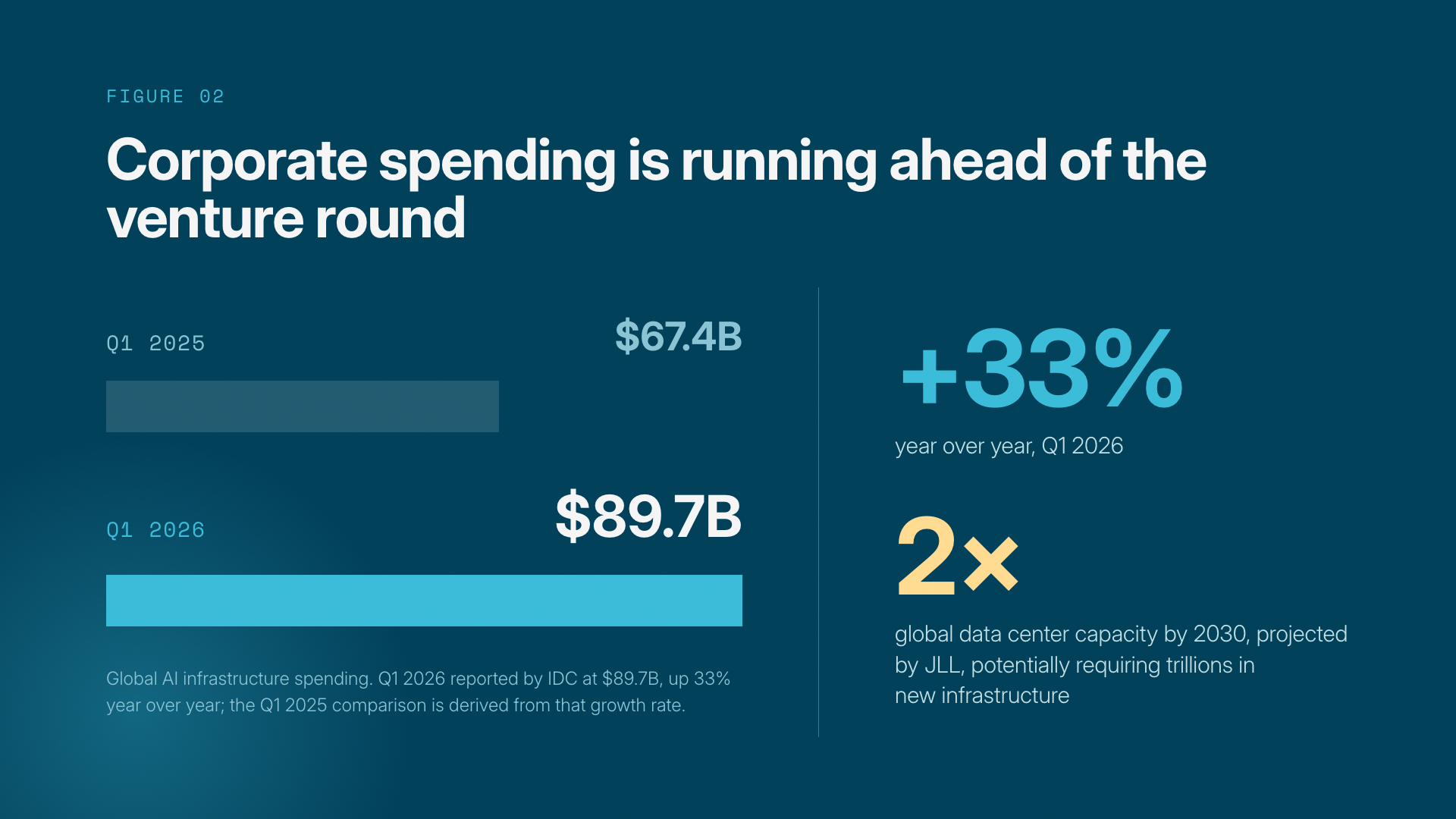
IDC reported $89.7 billion in global AI infrastructure spending during Q1 2026, representing 33% year over year growth.
JLL projects that global data center capacity could double by 2030, potentially requiring trillions of dollars in new infrastructure investment.
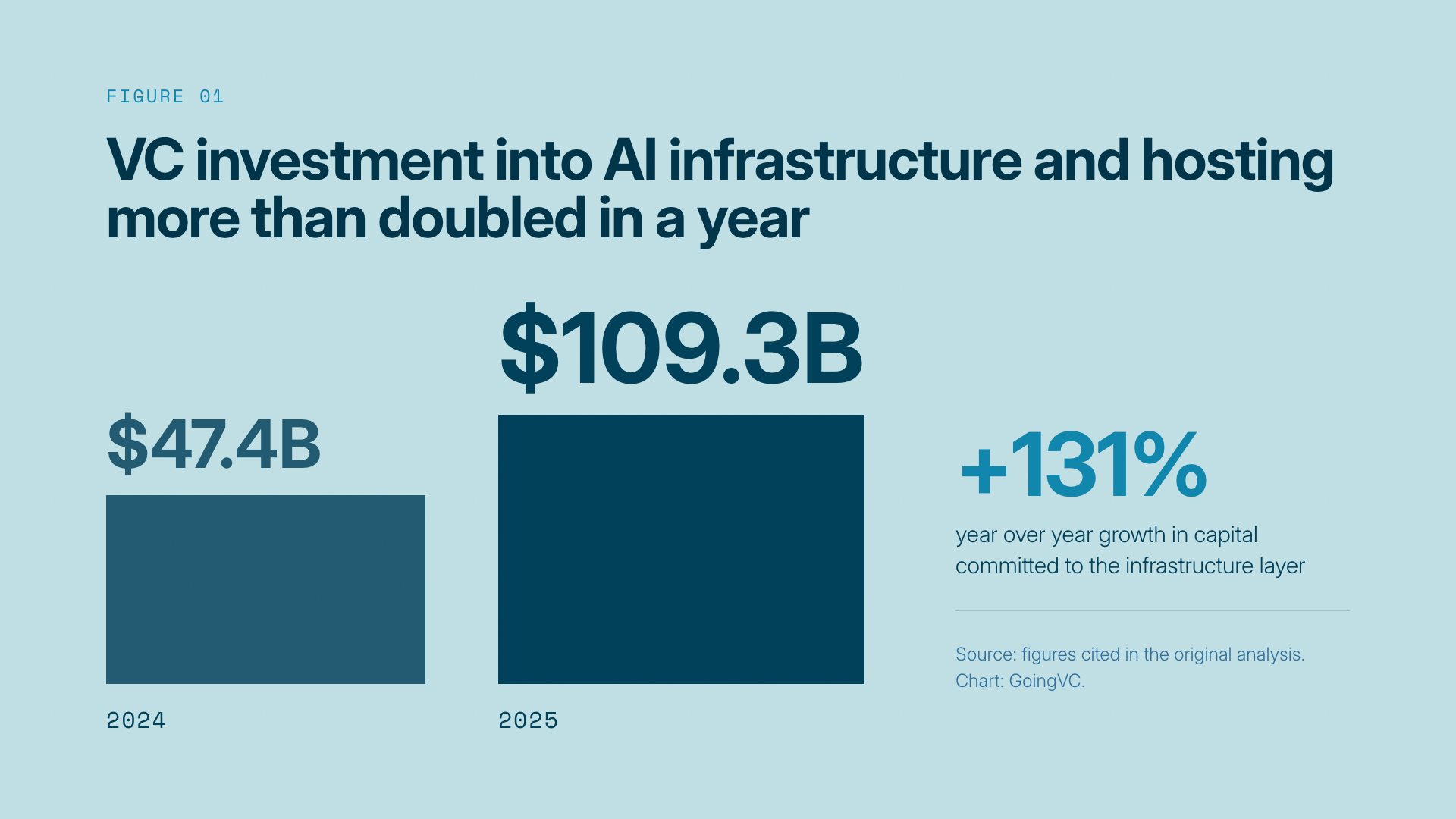
VC activity reflects the scale of the opportunity. AI infrastructure and hosting companies attracted $109.3 billion in investment during 2025, up from $47.4 billion in 2024, according to the figures cited in the original analysis.
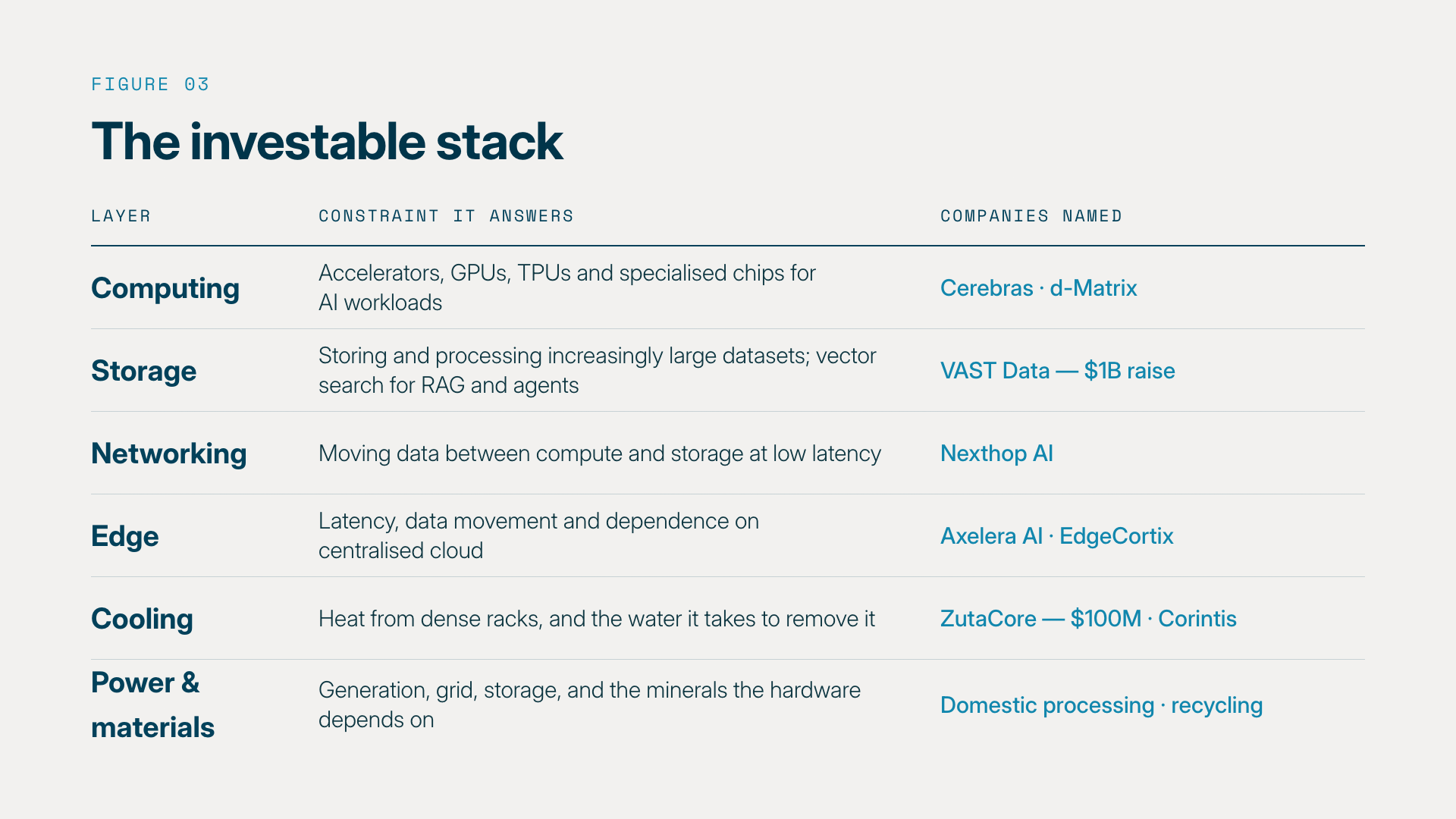
The opportunity spans multiple layers of the stack.
Computing
AI accelerators, GPUs, TPUs and specialized chips are becoming critical components of AI workloads.
Cerebras has raised substantial capital to develop large scale AI processors, while d-Matrix focuses on inference infrastructure designed to improve computing efficiency.
Storage
AI systems require infrastructure capable of storing and processing increasingly large datasets.
VAST Data raised $1 billion at a reported $30 billion valuation, reflecting demand for high performance data infrastructure.
Vector databases are also becoming important for applications such as retrieval augmented generation and AI agents.
Networking
AI workloads require large volumes of data to move between computing and storage systems with low latency.
Companies such as Nexthop AI are developing networking infrastructure specifically designed for large scale AI data centers.
Edge Computing
Some workloads are moving closer to the devices generating the data.
Edge AI can reduce latency, limit data movement and lower dependence on centralized cloud infrastructure. Companies such as Axelera AI and EdgeCortix are developing energy efficient processors for edge inference.
Cooling
Cooling technologies are becoming another investment category.
ZutaCore, for example, raised $100 million in 2026 to commercialize waterless direct to chip cooling for AI data centers. Corintis has also attracted investment for cooling technologies designed to improve water and power efficiency.

The Investment Thesis
The next phase of AI infrastructure will require capital across the physical stack.
Computing creates demand for chips. Chips create demand for power. Computing creates heat. Heat creates demand for cooling. Larger models create demand for storage and networking. Supply chain concentration creates demand for domestic production and processing.
Each layer creates another infrastructure requirement.
For venture capital, that creates a broad opportunity set spanning semiconductors, energy, cooling, networking, storage, materials and edge computing.
The AI buildout therefore extends well beyond the model layer. The infrastructure underneath the models is becoming an investment market of its own.
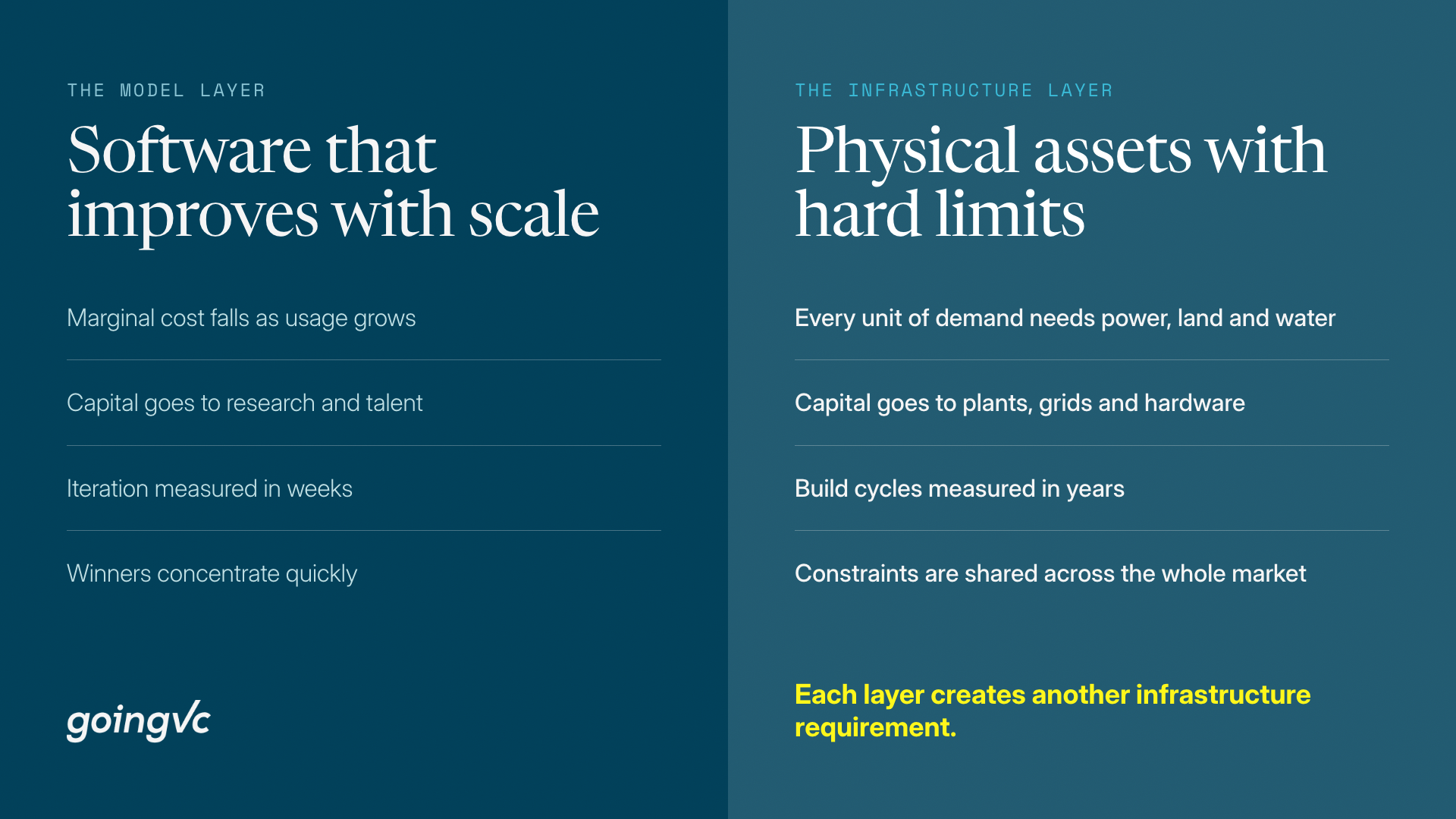
AI infrastructure is becoming a larger part of the venture landscape because the constraints are increasingly physical. More compute requires more power, cooling, storage, networking and materials.
For investors, the key question is shifting from which models will win to which infrastructure becomes essential as AI deployment scales. The companies that solve those constraints could become some of the most important businesses built around the AI economy.
Interested in the full research paper?
Join to receive Venture Capital research, guides, models, career tips, and many other great insights delivered straight to your inbox.