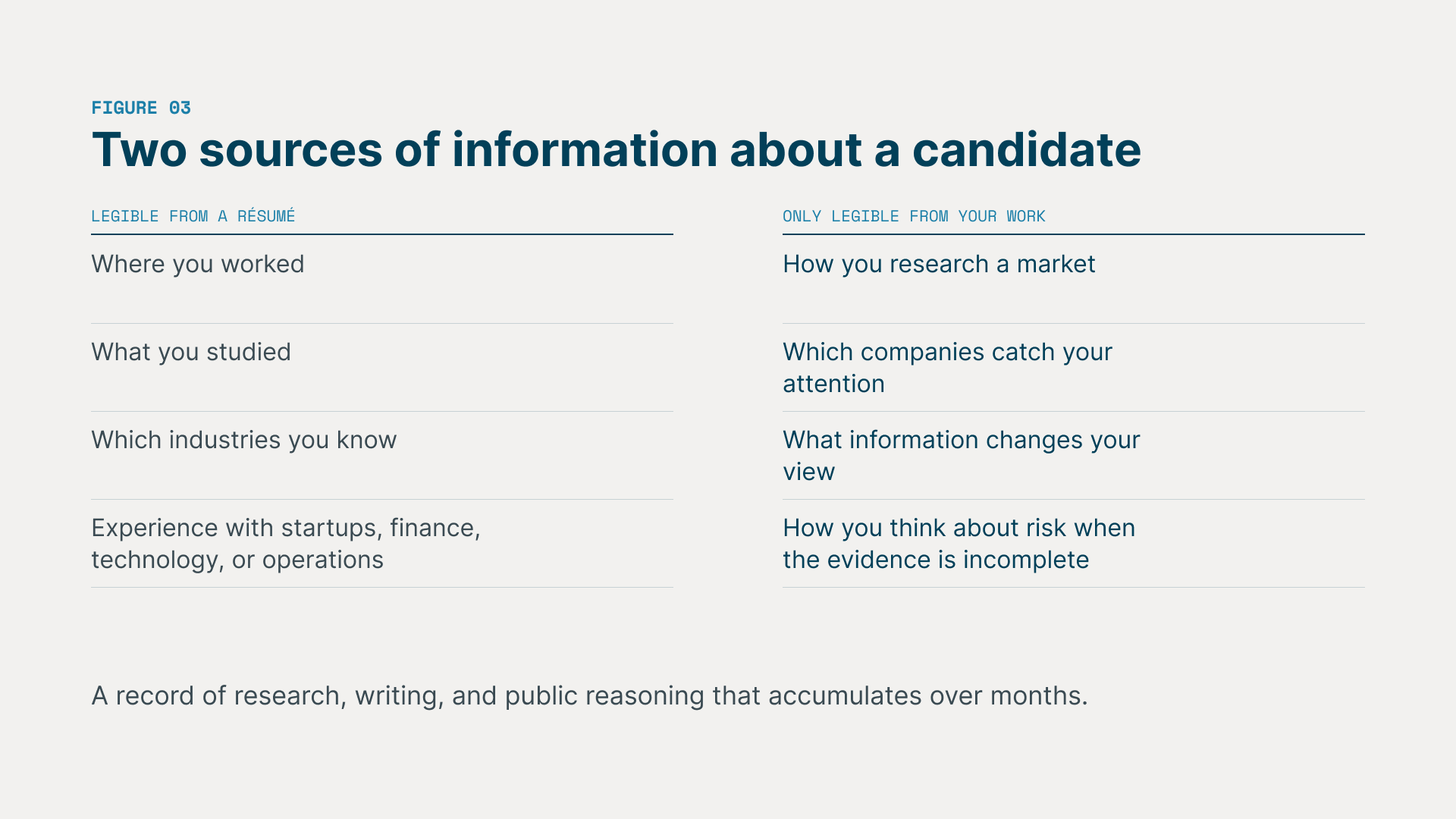
A venture capital firm can learn a great deal from a résumé. It can see where you worked, what you studied, which industries you know, and whether you have experience with startups, finance, technology, or operations.
Investment judgment is harder to read from a page of credentials.
How do you research a market? Which companies catch your attention? What information changes your view? How do you think about risk when the available evidence is incomplete? What do you understand about a sector that somebody encountering it for the first time might miss?
These questions matter because venture capital hiring rarely follows a single recruiting calendar. Teams are relatively small, openings appear at different points in a fund’s development, and relationships often play an important role in how candidates hear about opportunities.
For someone trying to enter the industry, this creates a useful opportunity. You can begin producing evidence of how you think before a firm has a role available.
Your LinkedIn profile, investment writing, market research, public discussions, and involvement in the startup ecosystem can gradually create a body of work that other people can examine. A thoughtful online presence gives investors another source of information when they encounter your name through an application, introduction, event, or conversation.
The work itself determines how useful that presence becomes.
Start by making your profile legible
Before publishing investment analysis, look at what someone sees when they first search for you.
A LinkedIn profile usually becomes one of the first public records of your professional history. For an aspiring investor, it should make your trajectory understandable within a few minutes.
Your headline should accurately describe what you do or what domain you work in. Your About section can explain the areas you have spent meaningful time learning about. Experience descriptions should give enough context for someone to understand what you actually worked on. If you already publish research, write investment memos, support startups, source companies, or study a specific market, your profile should make that work easy to find.
Specificity helps.
Someone with several years in healthcare operations may already have useful knowledge about how hospitals buy software, how reimbursement affects adoption, or where implementation tends to break down. Someone coming from cybersecurity may understand technical buyers, product categories, or emerging attack surfaces. Someone who worked inside a consumer startup may know far more about acquisition economics or retention behavior than their job title communicates.
Those details give an investor context for the perspective you may bring to a team.
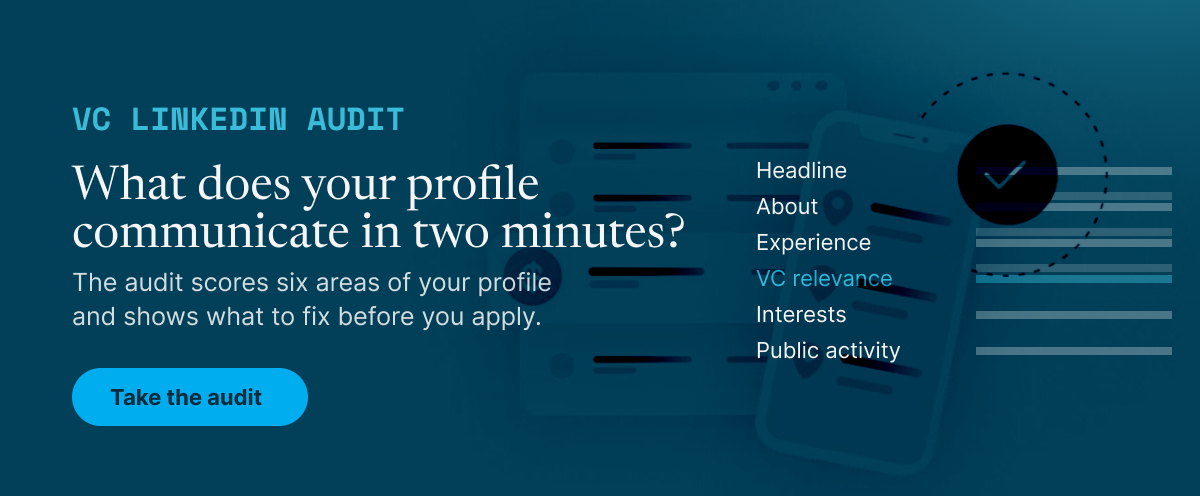
GoingVC built a LinkedIn Audit to help candidates examine this part of their online presence. It scores a profile across areas such as the headline, About section, professional experience, VC relevance, interests, and public activity. The score is a diagnostic for how clearly the profile currently communicates your positioning. It can also identify sections that deserve another look before you begin directing people toward your work.
Once the profile is coherent, the larger question becomes what you give people to find.
Make your investment judgment visible
Publishing can help because it leaves a record of your reasoning.
The subject matters less than the quality of the thinking. A useful post can examine a company, a market, a technology, a funding round, or a question you encountered while researching a sector.
The strongest pieces usually contain a clear claim and enough reasoning for another person to understand how the author reached it.
Consider a candidate researching vertical AI. A broad summary of the category tells the reader that the candidate has followed the market. A deeper analysis could examine why a particular workflow appears suitable for vertical software, what customer behavior supports that view, which companies are approaching the problem differently, and which developments would weaken the thesis.
That gives the reader material to evaluate.
The same principle applies when you disagree with a common assumption. Explain the assumption, identify the evidence you have examined, and show how that evidence shaped your conclusion. Make uncertainty visible when it matters. Investment decisions regularly involve incomplete information, so the ability to separate evidence, inference, and conviction is useful in its own right.
Public writing also creates opportunities for other people to challenge the reasoning. A founder may tell you that your view of the sales cycle misses an important constraint. An investor may point toward a company you overlooked. An operator may explain why a category that looks attractive from the outside has difficult implementation economics.
Those exchanges can improve the original analysis. They also create a public record of how you respond when someone introduces better information.
Over time, revisit some of your earlier views. Explain which assumptions held, which changed, and what you learned.
Investment memos are useful partly because they preserve a decision at the point when the outcome remains uncertain. Bessemer Venture Partners has published historical material from investment memos for companies including Twitch and Shopify. Reading them years later is valuable because the original reasoning remains visible. The eventual success of the companies does not erase the risks, unanswered questions, and assumptions the investors had to work through at the time.
Your public work can create a smaller version of that record.
AI has raised the standard for public investment writing
Generative AI has made it easy to produce clean summaries, market overviews, and professional sounding posts. That changes what a piece of public writing tells the reader.
A well structured post can now be created with very little direct exposure to the subject. Harvard Business Review recently examined this problem in the context of thought leadership, describing a growing supply of polished content that carries limited original insight.
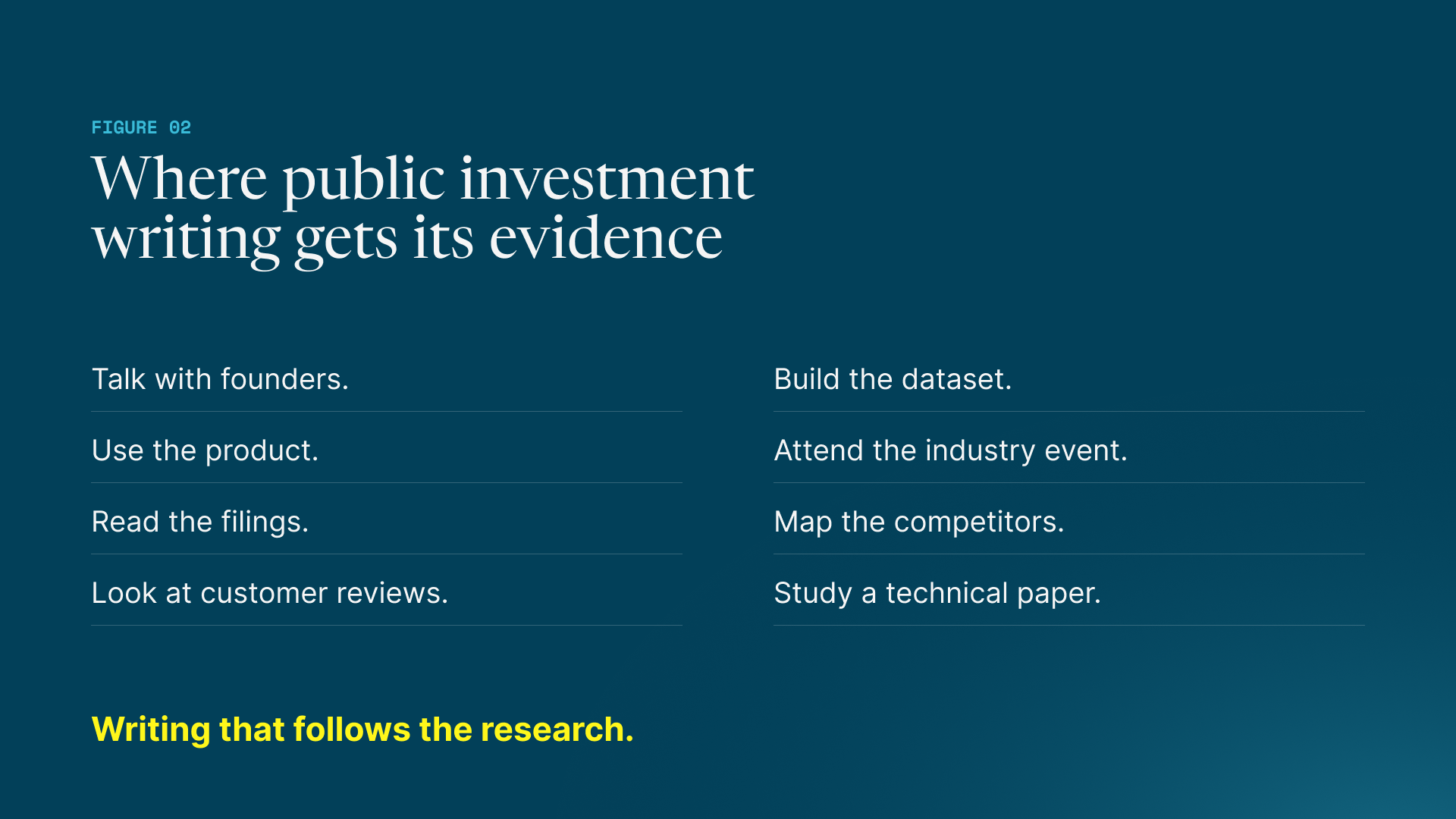
For someone building a reputation in venture, the practical response is to work closer to primary material.
Talk with founders.
Use the product.
Read the filings.
Look at customer reviews.
Build the dataset.
Attend the industry event.
Map the competitors.
Study a technical paper.
Follow a company long enough to observe how its strategy changes.
Bring your previous operating experience into the analysis.
Then write from what you found.
AI can still support the process. It can organize notes, help interrogate an argument, summarize source material, identify missing questions, and improve prose. The underlying observation and reasoning should remain connected to work you actually did.
This becomes especially important in venture because the industry places substantial value on information. An investor who repeatedly identifies useful information, asks good questions, and develops informed views becomes easier to understand professionally.
Your online presence should preserve traces of that process.
Build a small portfolio of investment work
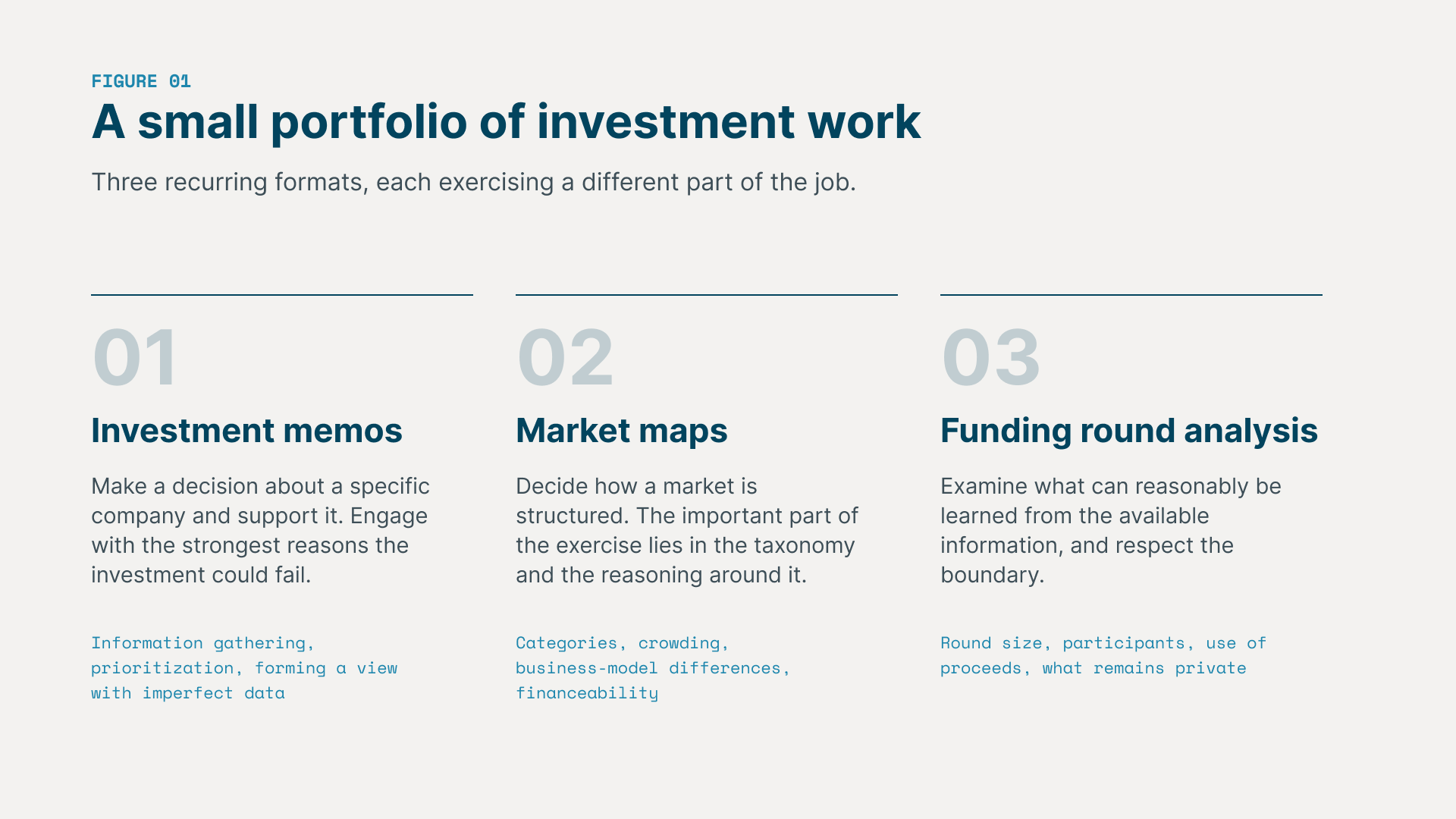
A candidate can make investment skills more concrete through a few recurring formats. Three are particularly useful because they exercise different parts of the job.
Investment memos
An investment memo asks you to make a decision about a specific company and support it.
The format varies across firms, although common components include the company and product, market, team, traction, competition, business model, investment thesis, and major risks.
The risks section deserves serious attention. A useful memo engages with the strongest reasons the investment could fail. It also identifies which unanswered questions would matter most before reaching a decision.
Bessemer’s published investment material provides useful examples. Its 2012 Twitch recommendation examined the company’s team, user growth, engagement, strategic partnerships, competition, and uncertainties before recommending an investment. The document is useful today because the reasoning predates the outcome.
For a candidate, a hypothetical memo on a company they have researched can demonstrate several skills at once: information gathering, prioritization, financial reasoning, market analysis, and the ability to form a view with imperfect data.
Market maps
A market map tests a different skill.
You have to decide how a market is structured.
Lightspeed Venture Partners’ enterprise AI market map, for example, organized more than 200 startups across foundation models, enablement platforms, and applications, then developed an argument about where the firm expected enterprise value to emerge.
The important part of the exercise lies in the taxonomy and the reasoning around it.
If you mapped fifty companies in climate software, fintech infrastructure, AI security, or digital health, which categories would you create? Why do those categories matter? Which parts of the market appear crowded? Where are companies solving closely related problems through different business models? Which areas remain difficult to finance?
Two people can examine the same group of companies and organize them differently. Those choices reveal how each person understands the market.
Funding round analysis
Publicly announced funding rounds provide another useful practice ground.
Take a recently financed company and examine what can reasonably be learned from the available information.
What does the size of the round suggest about the company’s ambitions or capital needs? Who participated? What experience do those investors bring to the company? How has the company described its use of proceeds? What has changed since the previous financing? Which details remain private?
The last question matters.
Public announcements rarely provide enough information to recreate the investment decision. Good analysis respects that boundary. Label what is known, identify reasonable inferences, and leave genuinely unknown information unresolved.
That discipline reflects a real part of venture investing. Investors constantly make decisions with uneven access to information.
Together, memos, market maps, and deal analyses can form a compact portfolio of investment work. They give someone reviewing your profile concrete examples of how you approach companies, markets, and incomplete evidence.
Develop a recognizable area of interest
A body of public work becomes easier to understand when some intellectual continuity develops across it.
You do not need to choose a sector for the rest of your career. Early research benefits from enough concentration to develop knowledge that accumulates.
If you publish about AI infrastructure this week, consumer marketplaces next week, biotech the week after, and defense technology after that, each piece may still be thoughtful. A reader has fewer opportunities to see your understanding deepen.
Following a market for several months gives you more context. You begin recognizing companies, founders, technical approaches, business models, financing patterns, and recurring disagreements. New information has somewhere to attach.
Eventually, people may begin associating you with a particular subject because you have done enough work in public to make the interest credible.
GoingVC alumnus Shawn Xu offers a useful example of what this can look like at a much more advanced stage. Shawn is now a Partner at Lowercarbon Capital and has built a substantial public presence around early stage investing, company building, and climate. His LinkedIn audience has grown to roughly 24,000 followers.
The follower count is secondary to the pattern of activity. His public profile reflects the same professional world he operates in: early stage companies, founders, climate technology, venture, and community building. Someone encountering several pieces of his work can quickly form a picture of the markets and problems that occupy his attention.
That coherence is useful for anyone building an investor identity, even with a much smaller audience.
[Pending Shawn’s permission before publication.]
Use public discussion as part of the research process
Posting creates another useful surface for learning because other people can respond.
Thoughtful comments on an investor’s article, a founder’s product announcement, or a market discussion can help you participate in conversations that are already happening. The quality of the contribution matters more than its frequency.
Read the argument carefully. Add information when you have it. Ask a question that advances the discussion. Explain where your experience leads you toward another interpretation.
The same standard applies to your own posts.
When someone challenges an assumption, examine the challenge. If new information changes your view, document the update. If your original conclusion still holds, explain the reasoning.
This habit can also strengthen relationships over time. A person who repeatedly encounters useful questions or informed observations from the same individual begins accumulating context about how that individual thinks.
That context can make a future conversation easier.
Let online work lead into real relationships
Venture capital depends heavily on relationships because information and access move through networks of founders, operators, investors, experts, and limited partners.
An online presence gives you more ways to enter those networks with context.
If you have followed an investor’s writing for several months and have contributed intelligently to a few discussions, an eventual introduction starts with some shared intellectual ground. If you meet a founder at an event after researching their market, you can ask questions grounded in the problems they actually face. If someone finds your market map through LinkedIn, they already know something about your interests before deciding whether to respond.
Industry events can deepen these relationships because conversations move beyond prepared posts. Someone can question your assumptions, add context, or take the discussion in a direction you had not anticipated.
Follow-up also becomes easier when the conversation contained substance. Reference the specific topic you discussed. Send the article, company, dataset, or introduction that relates to it. Give the other person enough context to remember why the conversation mattered.
Over time, a collection of these interactions can become a genuine professional network.
Venture itself often extends responsibility through relationships and observed work. Scout programs provide one visible example. Firms including Sequoia have used networks of founders and operators to identify and support early stage companies. These programs have their own selection criteria and should not be treated as a standard route into a VC job. They still illustrate how useful access, judgment, and trusted relationships can create opportunities to participate more deeply in investing.
Give people enough evidence to form an informed view of you
An aspiring investor does not need thousands of followers.
A useful online presence can be quite small.
A clear profile, several thoughtful pieces of research, a well constructed memo, a market map, informed participation in industry discussions, and a growing set of genuine relationships can give another person meaningful information about how you work.
The process also has value before any hiring outcome. Researching companies improves company analysis. Mapping sectors improves market understanding. Writing forces assumptions into language. Public discussion exposes those assumptions to people with different information. Relationships introduce new sources, companies, and perspectives.
Over time, these activities create a record of your developing investment judgment.
When a venture firm eventually encounters your name, it has more than a statement of interest in venture capital. It has work it can examine, ideas it can question, and a clearer picture of the investor you are learning to become.
Interested in the full research paper?
Join to receive Venture Capital research, guides, models, career tips, and many other great insights delivered straight to your inbox.