Venture studios — sometimes called startup studios, venture builders, or company builders — are growing into a recognizable model for creating companies at scale. Stanford GSB notes that the number of venture studios has increased by over 600 percent since 2013, and a 2024 landscape analysis counted more than 1,100 studios founded worldwide.
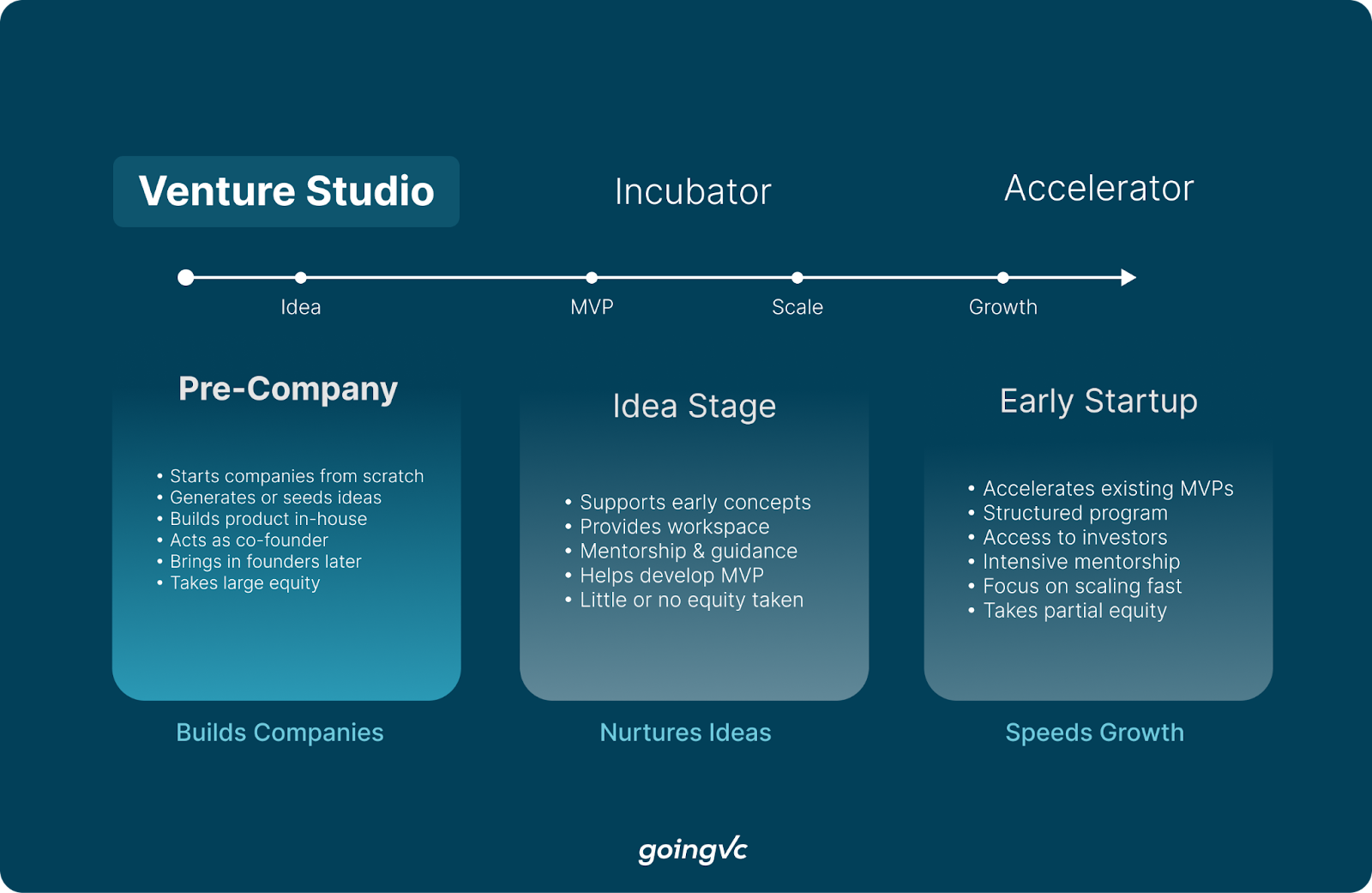
What Is a Venture Studio?
A venture studio is an organization built to repeatedly create startups using a shared platform. That platform includes a process for generating and stress-testing ideas, a validation playbook for testing assumptions before significant capital is committed, and centralized functions — product, engineering, design, recruiting, legal, finance — that any new venture inside the studio can draw on.
The defining feature is operational involvement. A studio doesn't just fund a company; it participates in building it, often before there is a founding team or a product.
This is what distinguishes it most clearly from a venture capital firm, but it also distinguishes it from accelerators and incubators, which are often misunderstood as synonyms.
An accelerator typically works with companies that already exist. A team has formed, an idea has been chosen, and the accelerator's job is to help sharpen and accelerate what's already in motion — through mentorship, introductions, and sometimes capital, usually in exchange for a modest equity stake over a fixed program period of a few months. The startup looks to grow and the accelerator helps it move faster.
An incubator often operates earlier, providing space, community, and early support to nascent ideas. Refining the initial idea, product or service. Many incubators take little or no equity, and their involvement tends to be lighter-touch, more academic — less about execution capacity, more about environment and early guidance.
A venture studio, by contrast, often originates the venture itself. It may develop the idea internally, recruit or co-found the team, and remain operationally involved through the earliest stages. It may also contribute to a pivot, in which the company may come at a later stage, but pivots to a new market or product and the studio supports it structurally. Because it contributes substantive execution capacity — not just advice — it typically takes a larger equity stake than an accelerator or incubator would.
Studios typically command 30–60 percent equity, reflecting their role as co-founders who contribute ideas, teams, infrastructure, and funding — compared to the 5–10 percent an accelerator might take for a three-month program, or the 10–20 percent a VC takes in exchange for capital alone.
The tradeoff founders make is less initial ownership, in exchange for infrastructure, speed, and shared resources that would otherwise take months and significant capital to build independently. Studios, in this way, act as strategic and operational partners, not just capital.
After analyzing more than 110 startup failure post-mortems, CB Insights identified a recurring set of causes: insufficient market demand, capital running out, misaligned team composition, pricing problems, and competitive pressure. They tend to cluster around two root issues — building the wrong thing, and running out of time and money before finding the right thing.
Studios attempt to address both structurally.
On building the wrong thing, a studio's validation process is designed to surface "no market need" early — through rapid customer discovery and lightweight experimentation — before significant engineering or product investment has been made. The idea is to make the cost of being wrong small, so that the cost of being right compounds over time.
On running out of time and money, centralized infrastructure reduces the overhead burden on each individual company. Legal, finance, hiring, product operations — these functions exist inside the studio and can be extended to new ventures without each team rebuilding them from scratch. That lowers burn and creates a faster path to the point where a startup needs to stand on its own.
The Economics Behind Venture Studios
Studios earn returns primarily through equity ownership in the companies they help build. The structure varies, but common models include a pure equity arrangement — where the studio contributes people and infrastructure in exchange for a founding stake — or a hybrid model that combines equity with some fee-based revenue to offset ongoing operating costs. Some studios are paired with a fund, which allows them to earn management fees and carried interest alongside their equity positions.
The equity-first orientation aligns the studio's incentives with the company's long-term outcome. A studio that only makes money when its companies succeed has a compelling reason to reduce risk in misaligned or underperforming ideas earlier rather than sustaining them longer than is healthy. This is one of the more overlooked structural features of the model.
Studios can run what amounts to continuous due diligence on their own ventures in a way that external investors rarely can. A VC firm conducts diligence before writing a check, then transitions into a board-level relationship. A studio lives inside the company creation process every day — running experiments, adjusting product direction, and making resource allocation decisions in real time.
This proximity is genuinely valuable, but it comes with an honest caveat. Operational closeness doesn't automatically produce better judgment. A studio that is too invested — financially and emotionally — in a venture it originated can struggle to make a more rational decision than a traditional VC firm would. The same structure that enables faster iteration can, if the culture isn't right, enable slower exits from underperforming ideas.
Studios that maintain full operational control are thought to strongly influence their ventures' success rate through de-risking — but the broader dispersion in outcomes across studio types suggests the model is still in an evolutionary phase. The quality of the people running the process matters as much as the process itself.
Why the model is growing
Experienced operators and founders — especially after a first exit — often want continued involvement in building without returning to the isolation of a single-company journey. A studio offers repeated engagement across multiple bets, with infrastructure already in place. Several leading studios have raised hundreds of millions in LP capital, with investors including Marc Andreessen, Peter Thiel, Jeff Bezos, and Richard Branson backing the model
Capital markets have also grown more selective. When funding was more abundant, companies could raise on vision, team and previous experience. Now investors expect earlier evidence. Risk is more calculated under stricter funding. Studios, structured around early validation, are better positioned to produce it. And as the pipeline of experienced operators continues to grow — founders and executives who've been through a full company cycle and want a more systematic way to build again — the studio model offers a compelling structure for that ambition.
Studios can run ‘continuous due diligence’ on their own ventures in a way that external investors may not. Although studios are still exposed to the risk that proximity to the operation and decision power do not guarantee more success rate than a traditional VC firm, but the reasons are much more controlled.
The performance figures that appear in industry summaries — seed fundraising rates above 80 percent, Series A progression well above the market average, time to Series A roughly half that of independently-built companies — come largely from studio ecosystem research, including reports associated with the Global Startup Studio Network. These figures are cited widely, but the incentive structure of the organizations producing them is worth keeping in mind. They are directional, not definitive.
A different kind of ambition
A simple way to understand the model is to think of it like a bank that gives you a mortgage – but also reviews the renovation plans, advises and helps you figure out whether to rent it out or sell, and — if the numbers don't work — tells you honestly to tear it down and find a better one. A studio isn't just funding your company. It's inside the decision-making with you.
Venture studios are growing — not just in number, but in legitimacy. What's interesting about that isn't the capital flowing into the category. It's what the model itself represents: a more systematic, process-driven approach to company creation, built by people who've been through the cycle before and want to do it better the next time.
The venture ecosystem has always had room for different structures. Studios are one more proof that there's no single right way to build a company — and that the industry is still figuring out new ones.
Interested in the full research paper?
Join to receive Venture Capital research, guides, models, career tips, and many other great insights delivered straight to your inbox.