Founders spend years learning how venture capital works from one side of the table.
They pitch investors. Negotiate terms. Build boards. Report metrics. Hire teams. Miss targets. Raise another round. Sometimes they exit. Sometimes they shut the company down and start again.
That experience can make venture capital feel like a natural next step.
But does building a company actually prepare someone to invest in them?
The research suggests a more interesting answer.
Founder experience can be an advantage
Paul Gompers and Vladimir Mukharlyamov studied founders who later became venture capitalists. Nearly 7% of the VCs in their sample had previously founded a venture backed company.
The results varied significantly depending on the founder’s previous experience.
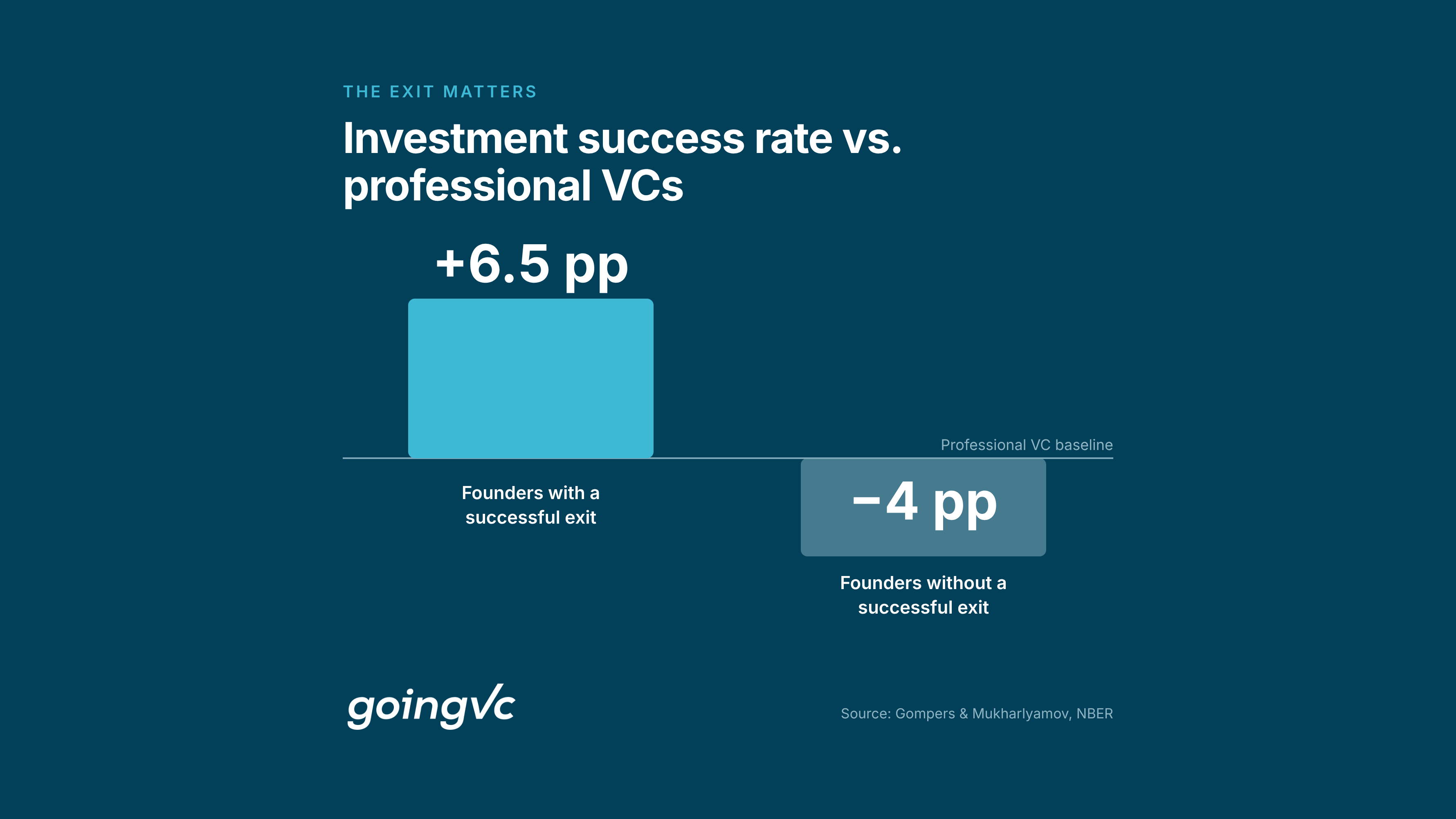
Former founders who had achieved a successful exit recorded investment success rates 6.5 percentage points higher than professional VCs. Former founders without a successful entrepreneurial outcome were 4 percentage points lower. (National Bureau of Economic Research)
Some of the advantage came from better deal flow. Successful founders often have stronger networks and access to higher quality opportunities.
But deal quality did not explain the full difference. The researchers found evidence consistent with successful founders also adding more value after investing. (National Bureau of Economic Research)
That makes intuitive sense.
A founder has experienced many of the problems they later evaluate as an investor.
They know what a difficult hire actually costs. They understand how quickly a promising sales pipeline can disappear. They have experienced product decisions where the spreadsheet could not provide an answer. They know how fundraising changes when runway starts shrinking.
Those experiences create context.
The harder question is whether that context becomes good investment judgment.
Investing is a different job
One of the largest studies of venture capital decision making surveyed 885 institutional VCs across 681 firms.
The researchers broke the job into sourcing, investment selection, valuation, deal structure, portfolio support, exits, internal firm management and relationships with limited partners. (National Bureau of Economic Research)
That is a much broader job than evaluating whether a startup looks promising.
The average firm in the study screened roughly 200 companies and made only four investments per year. Most opportunities came through networks or proactive sourcing. Only around 10% came directly from companies approaching the fund. (ScienceDirect)
VCs also ranked investment selection as the largest contributor to value creation, ahead of sourcing and post investment support. (ScienceDirect)
This changes the problem.
A founder learns to make one company work.
An investor repeatedly decides which companies deserve capital, which opportunities to pass on, how much ownership to pursue, when to follow on and how every individual investment fits inside a portfolio.
Founder experience informs those decisions. It does not replace learning how to make them.
What actually transfers?
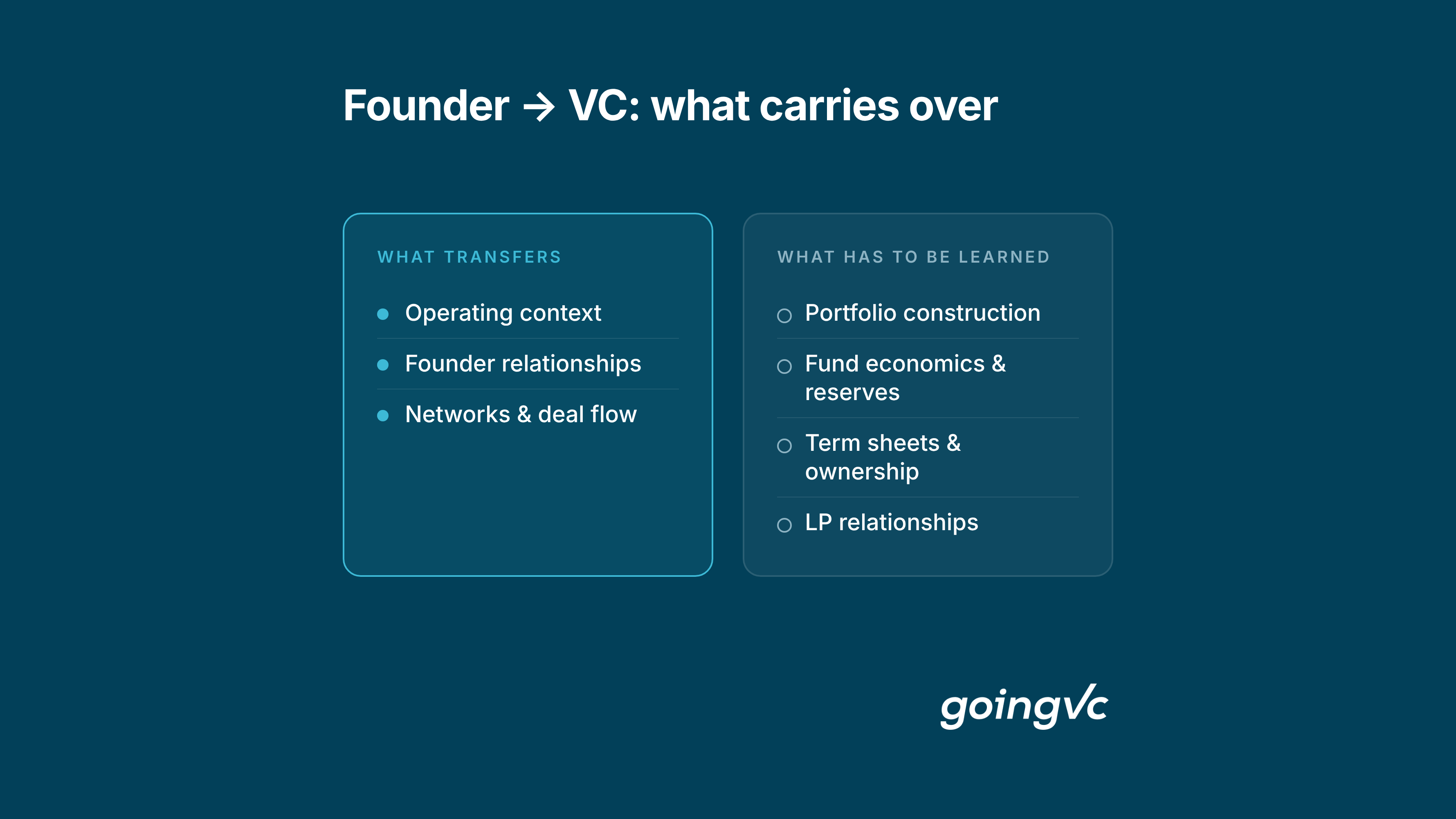
Three parts of founder experience seem particularly valuable.
1. Operating context
Founders have seen how companies behave between board meetings.
They understand the gap between a clean investor update and the hundreds of small decisions that produced it.
That context can make diligence more specific. Instead of asking only whether growth looks strong, a former operator might ask what organizational decisions created it, whether those decisions are repeatable and where the system could break.
2. Founder relationships
Having raised capital changes how you understand the founder investor relationship.
You have experienced investor communication when things are going well and when they are not.
That can make former founders especially useful after the check is written, when the investor’s role moves from evaluating the company to helping its leadership make decisions.
3. Networks
Founders accumulate relationships with other founders, employees, customers, executives and investors.
In venture, those relationships can become deal flow.
That matters because sourcing remains a core part of the job. Research on VC decision making shows that professional networks, other investors and portfolio companies generate a large share of investment opportunities. (ScienceDirect)
What has to be learned?
Founder experience can also become a constraint when someone assumes that their own company is a universal model for how startups work.
Investing requires learning to distinguish experience from pattern recognition.
Your company may have won through enterprise sales. Another may depend on product led growth. Your market may have rewarded aggressive expansion. Another may punish it.
The investor needs enough distance from their own operating history to evaluate what works in a different context.
There are also entirely new disciplines to learn.
Portfolio construction. Fund economics. Ownership strategy. Reserve planning. Term sheets. LP relationships. Investment committee dynamics. Fundraising. Follow on decisions.
These rarely appear in a founder’s day to day job.
Five questions for founders considering VC
The transition becomes clearer when you ask what part of venture actually attracts you.
- Do you enjoy evaluating companies as much as building them?
- Can you turn your founder network into consistent, differentiated deal flow?
- Can you develop an investment thesis that extends beyond your own operating experience?
- Are you willing to learn fund mechanics and portfolio construction with the same depth you once learned your startup’s economics?
- Can you help a founder make a better decision without becoming the operator again?
A successful exit can create credibility, capital and access.
It does not automatically create an investor.
The more useful advantage comes from converting years of operating experience into something portable: better questions, better judgment, stronger founder relationships and a clearer understanding of how companies actually get built.
That is where the founder to VC path becomes interesting.
The founder already knows what it feels like to sit across the table.
The next skill is learning how to make decisions from the other side.
Interested in the full research paper?
Join to receive Venture Capital research, guides, models, career tips, and many other great insights delivered straight to your inbox.