reaking into venture capital can be daunting without knowing where to start, many get stuck on finding a clear answer to: Why are you the right person for this role? When asked during an interview. And the reason behind it is actually quite simple, you are aligned.
As of the start of 2025, there are approximately 3400 active venture capital investors in the US, according to data from PitchBook. Each year, a small number of roles, comparative to other industries, such as technology, are open. That means you have a small pool with many fish. Now, you’ve done the work and gotten your background in check, you’re researching which courses you can take to strengthen your skill set and perhaps you even have the correct attitude and social response to interviews. You’ve now started applying, perhaps even getting interviews but the offers arrive slowly, if at all.
We believe, after a conversation with Sharran Deora, alumni of GoingVC, that the key differentiator may be finding fit. Sharran came from investment banking, product management and entrepreneurship background, he believed with a strong background breaking into VC would be easy. And while interviews came, he received less offers than he’d expect.
“I felt confident in my background. I felt fortunate that getting interviews wasn't the problem. Getting the offer was,” he said. “Experiences matter, but they only matter when they match what a firm actually needs.”
The Three Circles of Alignment
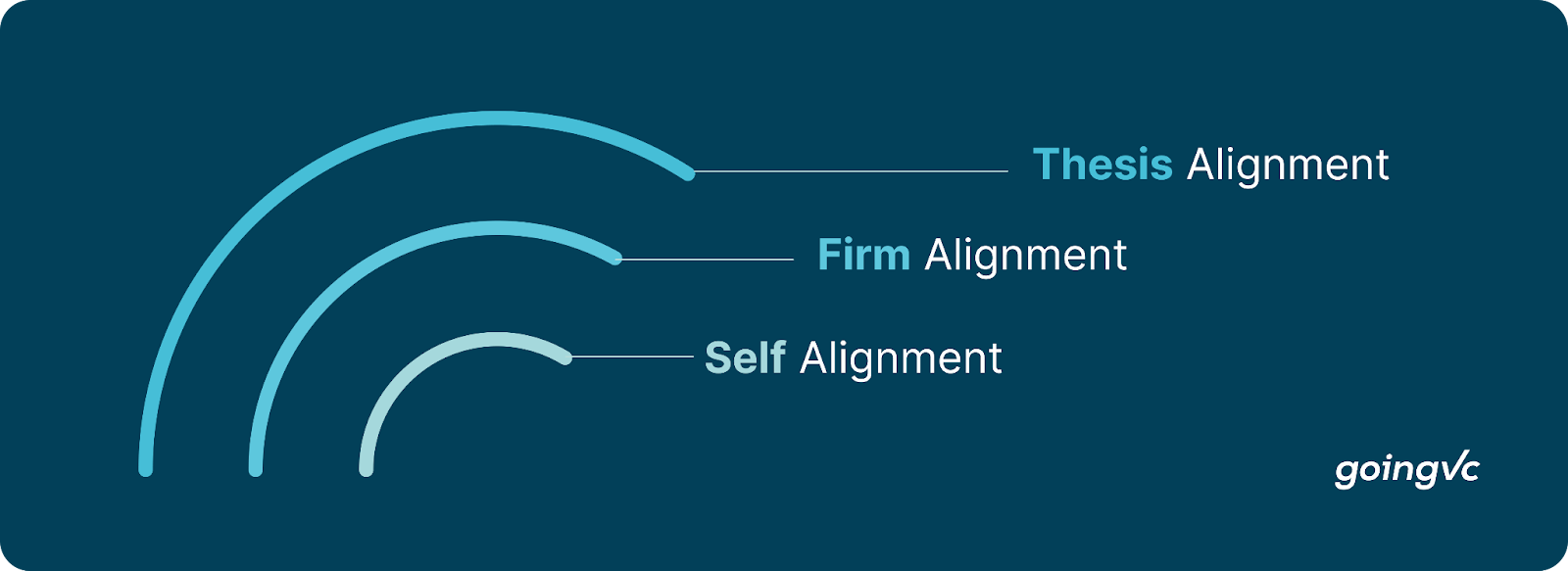
A career in VC can take shape in the overlap of three areas: self alignment, firm alignment, and thesis alignment.
Self Alignment:
Be truthful to yourself. Know your strengths
Before drafting your CV and applying to firms, you should carefully assess what you do best. You probably have a notion of what you naturally excel at when you have room to perform. It can help to view the VC Funnel and understand where you fall and what you excel at in this funnel:
The VC funnel has distinct stages, each requiring different strengths.
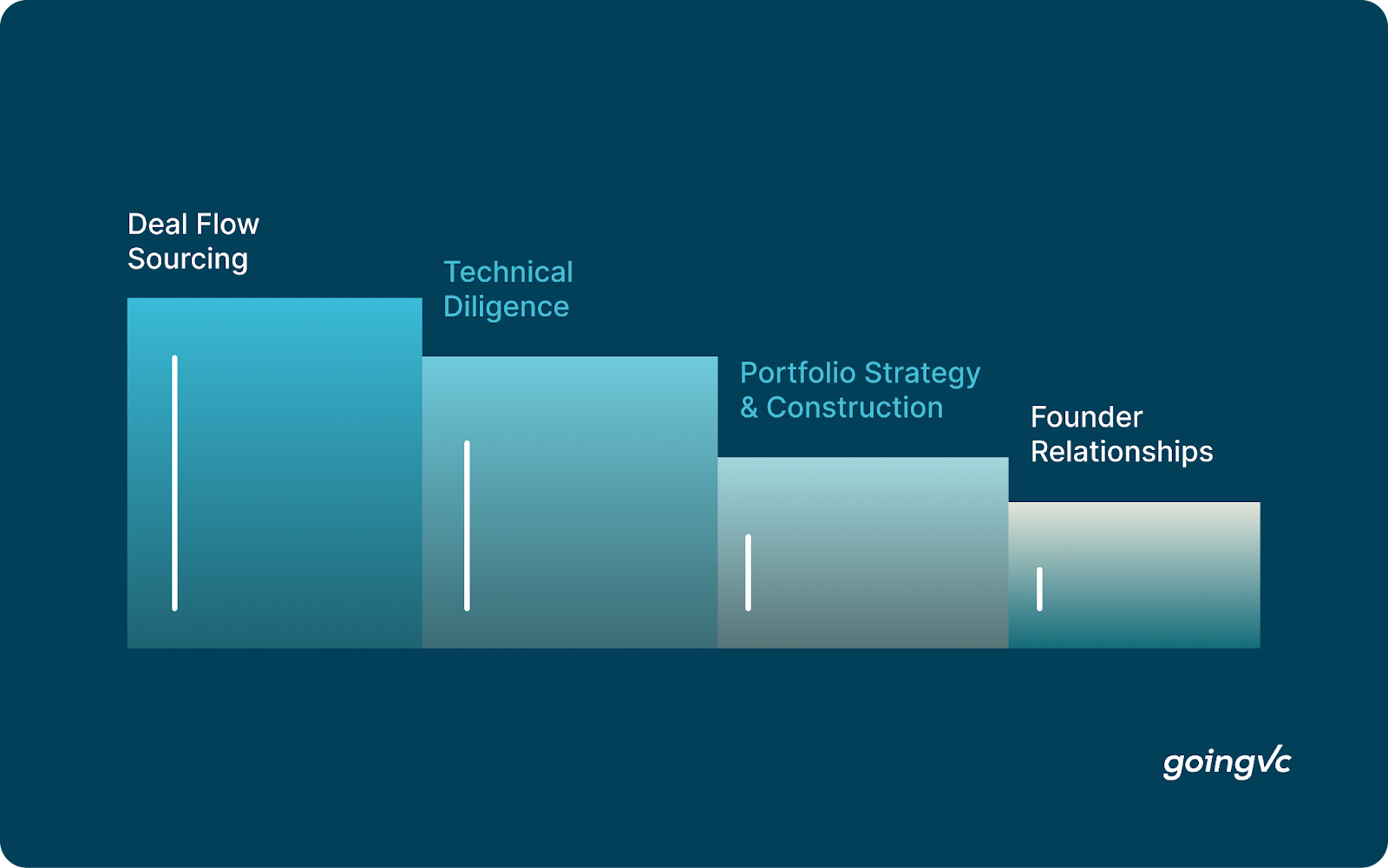
Deal Flow Sourcing: Building relationships, identifying emerging trends before they're obvious, earning founder trust in competitive situations
Technical Diligence: Are you technical on the product side? (Understanding architecture, user experience, technical feasibility) or technical on the finance side (unit economics, financial modeling, market sizing)?
Portfolio Strategy & Construction: Understanding how individual investments fit into broader portfolio theory, risk management, and fund dynamics
Founder Relationships: Do you excel at creating partnerships that help companies navigate growth challenges?
“Be self-aware,” Sharran said. “Where is your strength in the funnel? Deal flow? Technical diligence? Fundraising? Relationships? Know it clearly and lean on it”
Firm Alignment: Target Firms That Need What You Offer
Once you know your strengths, focus on firms where your expertise fills a real gap. Many candidates ignore this step and apply to roles that seem exciting, or focus on positioned firms. And although volume can create interviews, it may not always come accompanied by offers.
Examples of strong alignment and how to spot them:
If you excel at sourcing:
You’ll add the most value at emerging managers, newer funds, or firms outside major hubs. These firms need proactive sourcing to compete. Firmls like DV, or Fika Ventures operate this way.
If you excel at technical or product analysis:
Pre-seed to Series A firms rely on signals beyond traction. They need people who can assess feasibility, early product-market fit, and team capability when data is thin.
If you excel at financial and growth analysis:
Series B and later-stage firms lean on complex modeling, market structure analysis, and scaled unit economics. These firms write larger checks and rely heavily on this skill set.
Sharran put it bluntly:
“If my entire background is AI infrastructure, why would someone give me their money to invest in real estate? Alignment matters. Domain expertise can be a match to the firm’s focus.” Which in turn is a means of alignment. Subject matter expertise.
Thesis Alignment: Connect Your Strength to Their Strategy
One of the strongest forms of alignment is thesis alignment. Your thesis should bridge your background with a firm’s worldview.
“If you want to be a venture capitalist, your thesis matters,” Sharran said. “Start building theses. If it feels natural, that tells you a lot. If it feels forced, it may be signalling a gap in where you need to develop more knowledge and skill”
A thesis shapes your candidacy long before you enter the industry. It:
• Sharpens your thinking
• Signals seriousness
• Drives deeper interview conversations
• Reveals whether you’re in the right vertical
Sharran now sees about 5,000 deals each year and invests in only five—a 1,000-to-1 ratio. Recognizing signal depends on deep domain understanding,
Beyond the Background
One of the most persistent myths is that you need a specific background to enter VC.
“I came from a good background, and while that did get me lots of interviews, the background alone doesn’t help you break into VC”
Sharran added:
“If I knew then what I know now, I would have interviewed much better. I didn’t understand how deal flow fit within each firm. I didn’t understand how portfolio construction differed. I didn’t tailor my approach to the firm’s internal priorities.”
Alignment strengthens not only your chances of getting in, but also your long-term success. Early in your career, deal flow defines you. Ten years in, your ability to pick quality becomes the differentiator.
Learning from Mentors: Integrating Strengths with Intention
Throughout his career, Sharran integrated lessons from mentors who embodied different strengths:
For him, John Gannon modeled trust and transparency. Steve O’Hara showed the power of relationship-driven investing. SC Moatti demonstrated relentless energy needed to win allocations.
Our takeaway here is he didn’t copy anyone’s wholesale. He adopted specific strengths that aligned with his natural approach and long-term goals. This is alignment at the personal level: choosing traits that support your unique path.
Taking Action: Assess Your Alignment
If you're working toward a career in VC, here's how to assess and improve your alignment:
Step 1: Audit Your Strengths (What You Thrive In)
Ask yourself:
- In my past roles, what activities energized me versus drained me?
- What domain knowledge have I built through my years of lived experience.
- Where in the VC funnel would my skills create the most value?
Action item: Write down your top 2-3 superpowers with specific examples of when you've demonstrated them.
Step 2: Research Firm Needs (What the Market Needs)
Go beyond the job description. Understand:
- What stage does this firm invest in, and what skills does that stage require?
- Is this a brand-name firm that gets inbound deal flow, or do they need to work for allocations?
- What gaps exist in their current team? (Look at team bios, what expertise is missing?)
- What does their portfolio tell you about their actual strategy versus stated focus?
Action item: Create a spreadsheet of 10-15 target firms with notes on their needs and how you specifically could fill a gap.
Step 3: Build Your Thesis (The Bridge)
Choose a specific domain and develop a point of view:
- What trends are you seeing that others might be missing?
- Based on your experience, where are the opportunities in this space?
- What makes you uniquely qualified to evaluate companies in this vertical?
- Can you articulate this thesis in a clear, compelling way?
Action item: Write a 2-page investment thesis. If it's difficult, you might not know the space well enough yet. If it flows easily, you've found your alignment.
Step 4: Communicate Your Alignment Clearly
Once you understand your alignment, make it obvious in every interaction:
- Tailor your resume to highlight experiences relevant to each specific firm
- In interviews, connect your background directly to their needs (with examples)
- Share your thesis early and invite substantive discussion about the market
- Ask questions that demonstrate you've thought deeply about their specific challenges
Action item: Use resources like GoingVC's interview guide to practice articulating your alignment. Work with mentors or peers to ensure your story comes across clearly and authentically.
Ready to assess your alignment and communicate it effectively? Download GoingVC's interview preparation guide to help you articulate your unique strengths and find firms where you'll truly thrive. Our career accelerator program has helped hundreds of professionals break into VC by focusing on genuine fit, not just credentials.
Special thanks to Sharran Deora who generously shared his insights for this piece. The venture capital community thrives when experienced investors pay forward what they've learned, helping the next generation find their alignment and contribute meaningfully to the ecosystem.
Interested in the full research paper?
Join to receive Venture Capital research, guides, models, career tips, and many other great insights delivered straight to your inbox.