A founder with several term sheets on the table eventually asks the same question of each investor: what makes your capital different?
Capital Optics
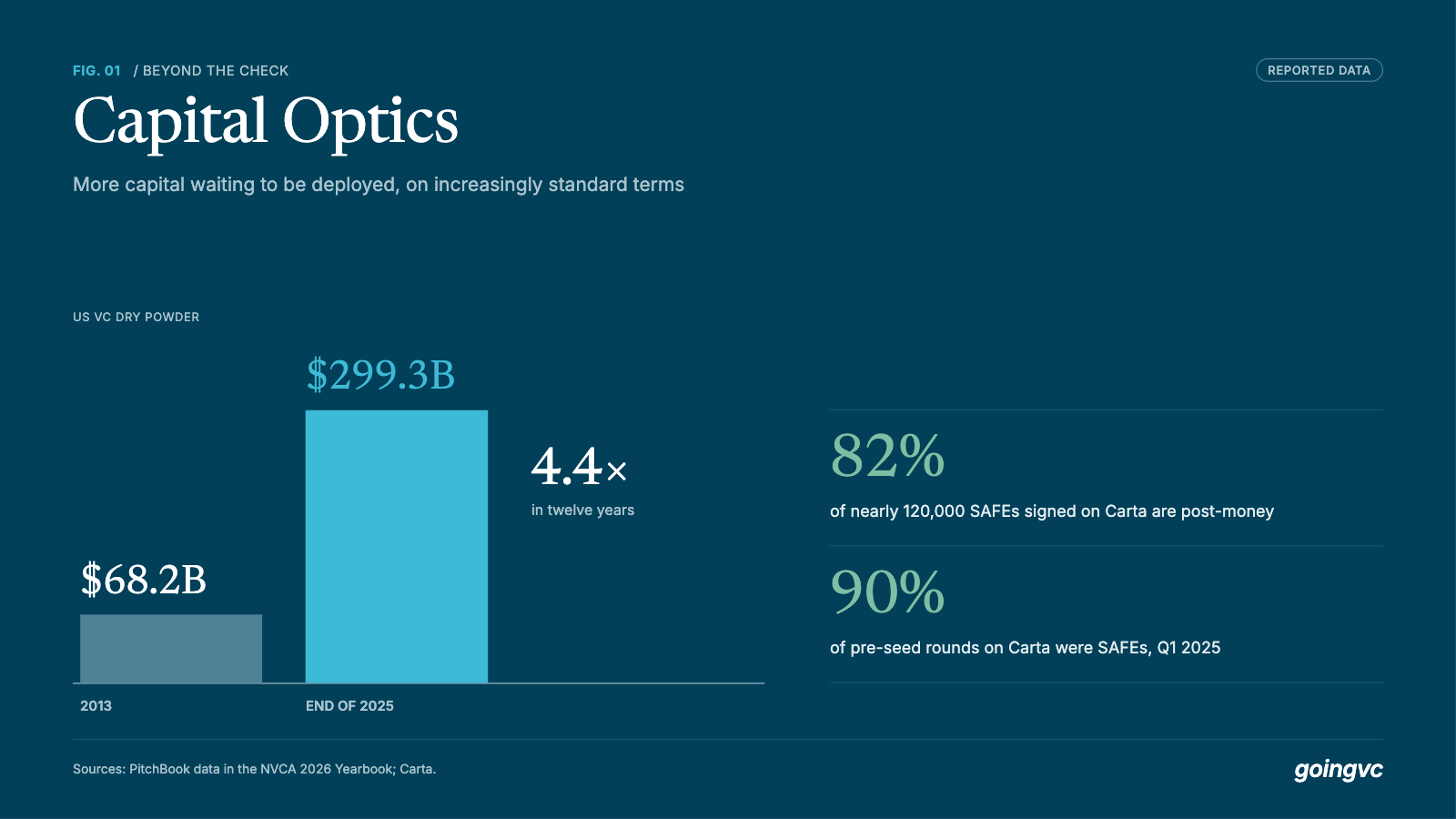
At the end of 2025, US venture funds held $299.3 billion in uninvested capital, according to PitchBook data in the NVCA 2026 Yearbook. In 2013, the figure was $68.2 billion.
Over the same period, the terms converged. Y Combinator moved its template to the post-money SAFE in late 2018, and the market followed. Of nearly 120,000 SAFEs signed on Carta, 82% are post-money. In the first quarter of 2025, SAFEs accounted for 90% of pre-seed rounds on the platform.
What founders expense
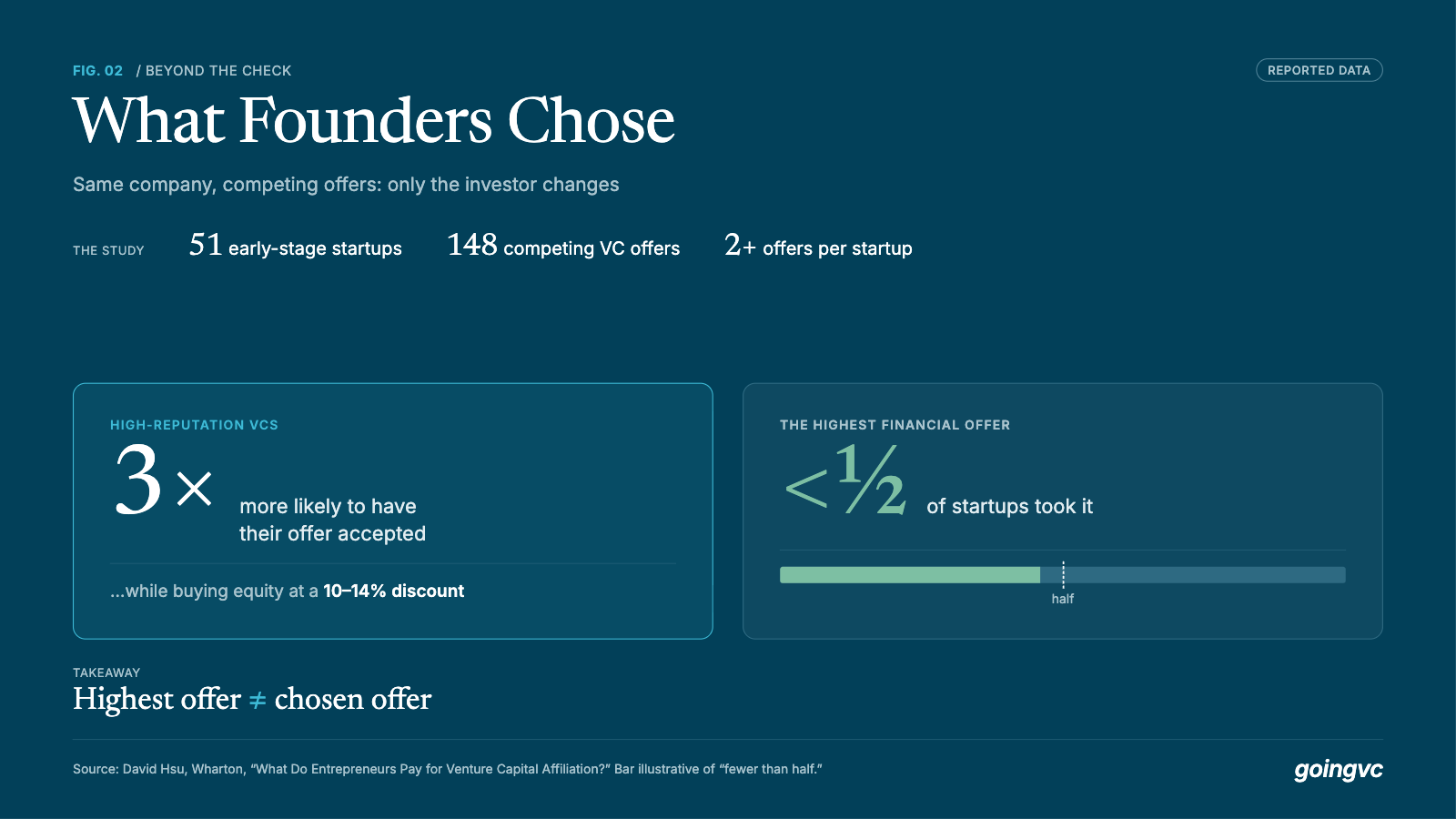
At Wharton, David Hsu studied 51 early-stage startups that together received 148 competing offers from venture firms. Every startup had at least two offers. With the company held constant and only the investor changing, the study could compare investors directly, and see which offer each founder chose.
Offers from high-reputation VCs were three times more likely to be accepted, and those firms bought equity at a 10 to 14% discount. Fewer than half of the startups took the highest financial offer.
Hsu concludes that a venture firm's non-financial value may be more distinctive than its capital.
Where the difference shows up
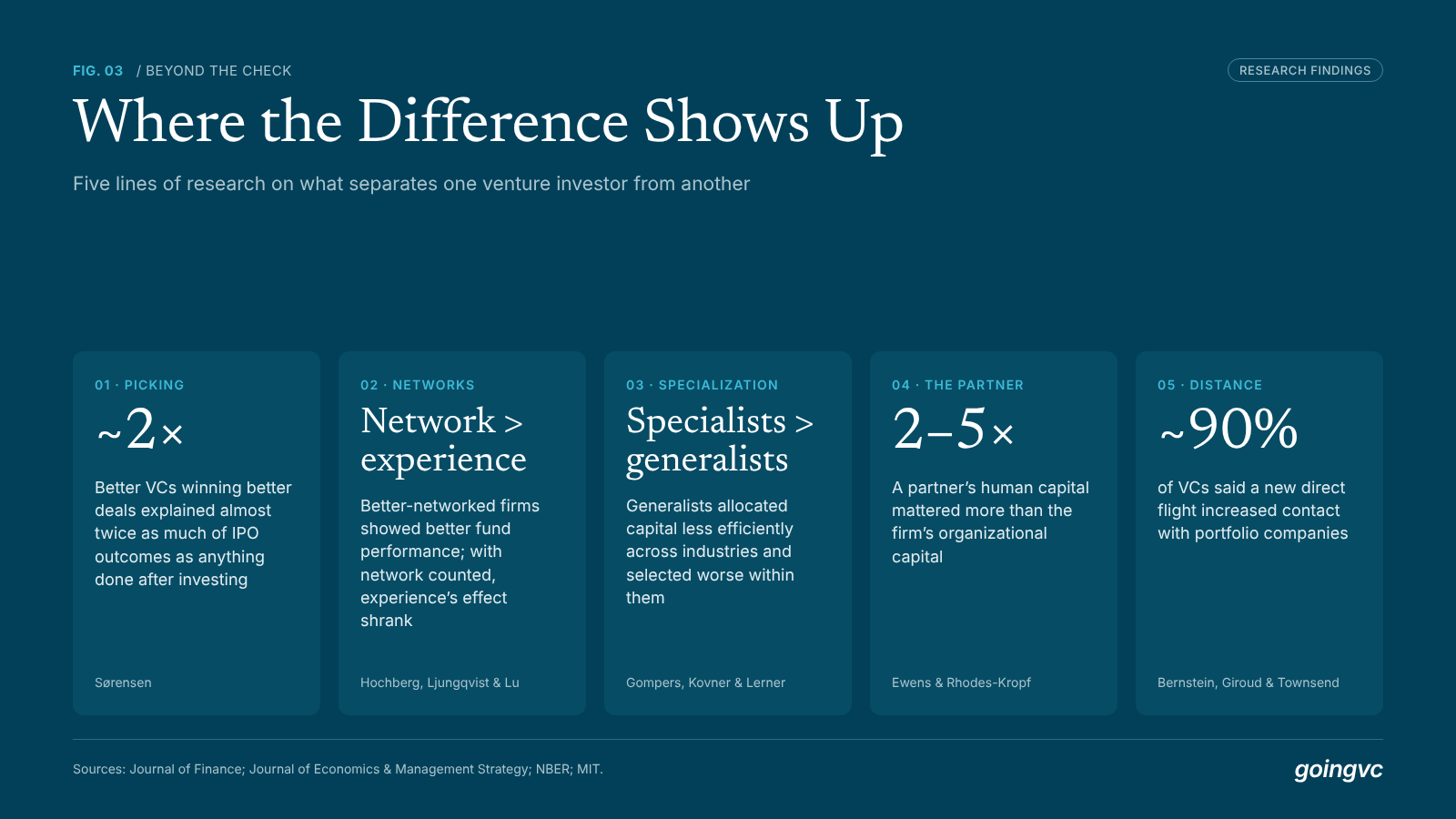
Picking. Morten Sørensen modelled how VCs and companies choose each other. Companies backed by more experienced VCs were more likely to go public. Yet sorting, better VCs winning better deals, explained almost twice as much of that gap as anything the VCs did after investing.
Networks. Yael Hochberg, Alexander Ljungqvist and Yang Lu mapped which US firms co-invested with which between 1980 and 2003. Better-networked firms reported better fund performance. Their portfolio companies were more likely to survive to the next round, and more likely to exit. Once network position was accounted for, the effect of investment experience shrank. In some models, it disappeared.
Specialization. Paul Gompers, Anna Kovner and Josh Lerner found that specialized VCs outperform generalists. Generalists allocated capital less efficiently across industries and selected worse within them. Where an individual partner was already specialized, firm-level specialization added little.
The partner. Michael Ewens and Matthew Rhodes-Kropf followed individual VCs as they moved between firms. Partners at the same firm, investing in the same years, showed different levels of skill. Their estimate: a partner's human capital is two to five times more important than the firm's organizational capital in explaining performance.
Distance. Shai Bernstein, Xavier Giroud and Richard Townsend used new direct airline routes as a natural experiment. When a new route shortened a VC's travel time to a company it already backed, that company innovated more and became more likely to exit. Almost 90% of VCs in their survey said direct flights increased their contact with portfolio companies.
The half-life of an edge
Skill, network and judgment can be treated as assets. Assets depreciate.
One way to measure this discounts each investment by the time since it was made, using a three-year half-life. Value created in 2023 counts for about half today. Value created in 2020, a quarter.
Two investors each put $10 million into a company for a 20% stake, and each company goes public this year at $10 billion. On paper, identical. One invested in 2005, the other in 2020. The second earned an IRR of 141.9%; the first, 28.7%. One record rests on human capital six years old. The other rests on human capital twenty-one years old, which under a three-year half-life counts for less than a cent on the dollar.

Other industries, same question
Talent agencies, consulting firms and investment banks sell access, advice and representation. When clients cannot tell the institutions apart, they tend to decide on four things: who the firm can put them in front of, whether it will act in their interest, how well it understands their exact problem, and the individual they will work with day to day.
Private equity took another route. Firms such as KKR built in-house operating teams, KKR Capstone the best known, to improve companies after buying them. That model rests on control. Buyout firms usually have it. Venture investors usually do not.
Finding the edge, and showing it
Across these studies, the same few factors keep returning: access to deals, the reach of a network, depth in a sector, a partner's own record, how recent that record is, and how present an investor is once the check clears. Capital is what founders compare on the term sheet. These are what they compare in reference calls.
An advantage carries weight when a founder can check it. A customer introduced last quarter. A senior hire placed. A follow-on round brought together. A founder from a difficult year who still takes the call.
Founders choosing between offers ask versions of the questions below. An investor working out where their own edge lies can ask them first:
- Which deals reach me that do not reach others, and why?
- Who does my network reach: customers, senior hires, follow-on investors? When did I last use it for a company?
- How deep is my expertise, and does it match the company in front of me?
- Which part of my track record is mine, and would it travel if I changed firms?
- How much of that record was built in the last three years?
- How quickly can I be in the room when a portfolio company needs me?
GoingVC helps investors build the network, judgment and deal experience behind those answers. Learn more about the GoingVC program.
Interested in the full research paper?
Join to receive Venture Capital research, guides, models, career tips, and many other great insights delivered straight to your inbox.