Science is an ecosystem, but it is also a pipeline.
Mathematicians often discover concepts such as complex numbers and curved space, just because it seems to explain the objects that they’re studying.
Then 10, 20, 50 years later, other scientists discover that those concepts are exactly what they need to understand a completely different problem.
When a problem can be better understood, new solutions can be tested, and those solutions can become useful technologies, or companies solving other problems.
We usually don’t see the full process, mainly because it can take decades to develop, and requires effort from a lot of people.
The technologies we use today are the result of a huge pipeline, that for it to happen, people doing fundamental science had to talk to people doing applied sciences, and they had to talk to people who are doing engineering, and they had to talk to people in the industry, who talked to investors, across disciplines, institutions and even generations, all tracing back to fundamental discoveries made by curious people trying to understand the world better.
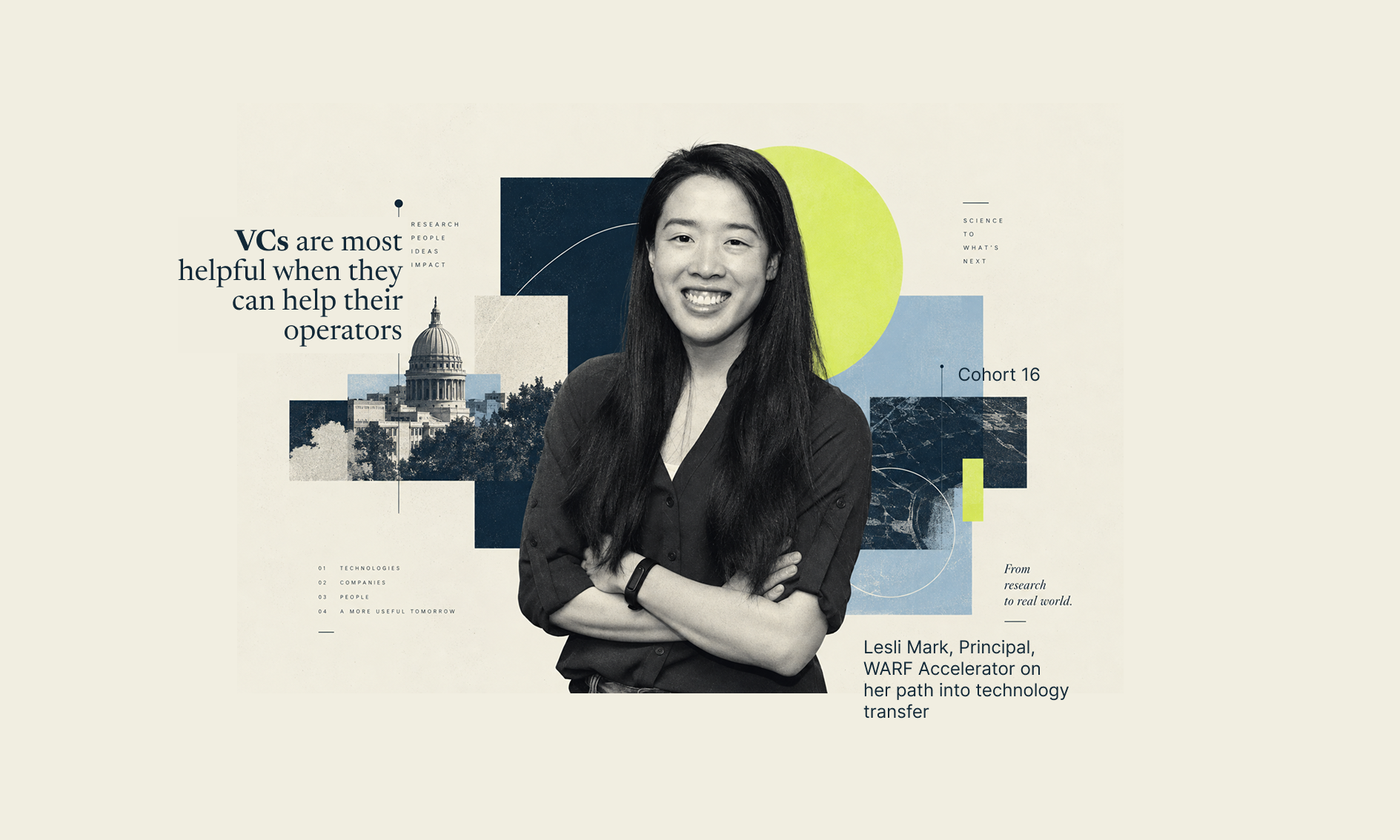
Technology Transfer is a key part of this pipeline. And one who has experienced it from several sides, is Lesli Mark.
Lesli serves as Principal at the Wisconsin Alumni Research Foundation, or WARF. She is a GoingVC alum and chemical engineer by training. Having started her career in research, she now brings that unique perspective into the development and commercialization of university technologies, helping move them through technical development, and in some cases, toward venture formation.
Moving inventions developed at universities and research institutions toward commercial use can take different routes. A university may license intellectual property to an established company. Researchers may form a startup around the technology. Inventions require technical work, market research, industry partnerships, or entrepreneurial talent before either path is clear.
That is part of what makes the field challenging. University inventions often emerge at such an early stage that their commercial value has yet to be realized.
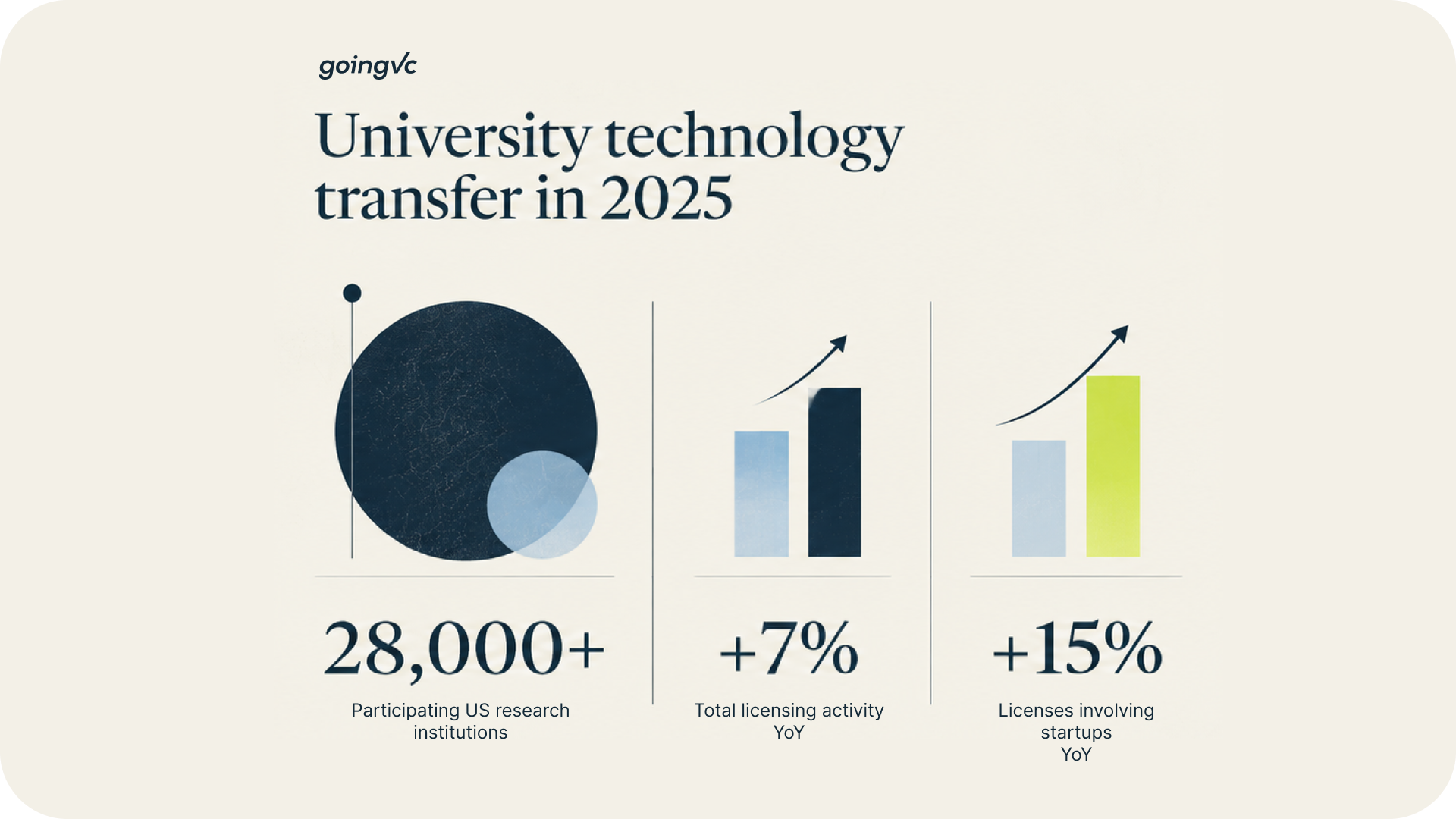
This activity represents a sizable part of the research economy.
In fiscal year 2025, participating US research institutions reported more than 28,000 invention disclosures. Licensing activity increased more than 7 percent from the previous year, while licenses involving startups increased 15 percent.
From research to commercialization
Lesli spent graduate school and her postdoc working primarily on fundamental science. She enjoyed novel research and difficult technical problems, and for years an academic career seemed like a natural direction.
During her postdoc, her PI gave her substantial responsibility, including writing grants and helping develop new areas of research. Her interests gradually expanded toward how scientific work could be applied.
"I really learned that what I love is impactful science," she said.
She began exploring startups and translational technologies and considering roles around the researchers building them.
"How else can I work with startups and translational technologies?" she remembers asking herself.
Technology transfer brought those interests together.
WARF works with inventions from the University of Wisconsin-Madison through patenting, licensing, industry partnerships, technology development, startup formation, and investment. It currently manages more than 630 active commercial licenses and signs about 55 revenue-generating licenses each year.
WARF has a venture arm that includes WARF Ventures, a direct investment fund for UW–Madison startups and companies based on WARF IP, and WARF Accelerator, which is not a traditional startup Accelerator, but rather it funds and drives pre-license technology, commercial, and talent development. Lesli leads WARF Accelerator and plays a key role in WARF Ventures, where she contributes to due diligence and leads select investment recommendations.
WARF Accelerator focuses on high-potential technologies that require further validation, prototyping, or scale-up to become compelling commercial opportunities.
The program provides targeted funding and industry expertise around commercially significant milestones, with projects spanning clean technology, engineering, agriculture, health care, and research tools.
The questions depend on the project, naturally.
A material may need a field-relevant performance test. A medical technology may require a clearer regulatory path. A research team may need market feedback. A potential startup may need someone prepared to lead it.
Lesli's work begins while those questions are still open.
For each technology, she identifies the commercial opportunity: the gap it fills in its industry and the preliminary beachhead market where it could gain traction. She then uses primary and secondary market research to help the team shape its milestones, so that each one is critical to commercializing the technology.
That work doesn't happen in a vacuum. Each technology gets its own group of outside reviewers, called Catalysts, assembled specifically for that field and technology. Rather than drawing from an existing pool, Lesli often brings in industry and venture experts who are entirely new to WARF's network, because the technology calls for knowledge that specific. They advise the team and help shape its commercial path.
Commercial paths at WARF
Alithic is one example.
The company is developing a carbon-negative supplementary cementitious material that can replace part of the Portland cement used in concrete. Its process captures CO2 and mineralizes it with low-value industrial materials, permanently storing the carbon while turning waste into a potentially lower-cost building material.
Through WARF Accelerator, Lesli's work funded both technical and talent de-risking. The technical work included testing the system on real-world feedstocks to measure key figures of merit such as reactivity and concrete performance, life cycle and techno-economic analysis (LCA and TEA), and a bench-scale prototype. On the talent side, an entrepreneurial lead was recruited for the project and later became CEO. Lesli subsequently supported due diligence for WARF Ventures' initial investment in the company.
Flux XII developed along another route.
The company is working on long-duration energy storage using aqueous organic redox flow batteries. Lesli has worked with the technology since joining WARF, including funding technical milestones such as prototype development of the electrolyte and membranes and techno-economic analysis, supporting startup formation, and leading the investment recommendation through WARF Ventures.
Across both companies, Lesli's involvement spans nearly every stage, from early-stage research to venture investment. She brings scientific rigor, commercial judgment, a network she has cultivated of people who can add real value, and a real commitment to seeing the technologies succeed.
Exploring a venture case
Lesli has also developed different talent models to support startup formation around WARF Accelerator technologies: a Fellowship for emerging technical founders exploring whether their research supports a startup opportunity, and an Entrepreneurial Lead engagement, where an experienced entrepreneur is matched with a defined WARF Accelerator technology that has already been somewhat de-risked.
Researchers enter with deep knowledge of the underlying technology. Entrepreneurs enter with deep knowledge of the industry and market. These engagements add questions around the technology's potential application and commercial environment.
What problem does it solve?
Who might need it?
Which application warrants further work?
What evidence would a customer, commercial partner, or investor need?
What would a company built around the technology require?
The engagements give founders time to work through those questions while developing relevant knowledge, relationships, and, just as importantly, confidence.
The process can also change the next technical milestone.
Customer conversations may identify a performance requirement that matters more than the metric currently being optimized.
Industry feedback may narrow the initial application.
Market research may point toward a licensing partner with infrastructure already in place.
A venture case develops through the interaction between the research and its potential use. It's a symbiotic relationship that develops in a unique environment.
When a venture case holds up, the company still needs rights to the underlying technology. For eligible UW founders, WARF's Startup Advantage program provides standardized licensing terms and a defined route toward an exclusive license.
Skills that carry from research into venture
Lesli came into technology transfer with years of scientific training. She built the venture side deliberately: financial modeling, investment theses, fund structures, business models, and venture math, through coursework, independent study, and GoingVC.
"The financial modeling and creating an investment thesis really helped me think about how to think like a VC," she said.
We'd argue research is some of the best venture training out there. Scientists spend years forming hypotheses, pressure-testing evidence, and updating their view when the data says so. They get comfortable with incomplete answers, because experiments rarely (if ever) settle everything at once. Venture runs on the same constraint. You build a view with what you have, keep refining it, and with enough reps it becomes instinct. (Investors call it gut. A scientist would probably ask to see the data.)
Lesli's work shows what that combination looks like in practice. In the same stretch of weeks, she might be assessing whether a cement technology can perform with real-world feedstocks at a cost and scale producers can adopt; whether a flow battery's electrolyte and membrane can deliver the lifetime, safety, and economics customers need; or whether a radiopharmaceutical has the clinical differentiation and development path to attract a licensing partner.
Her work is to identify the commercialization figures of merit: the evidence that shows a technology solves a real problem, offers a meaningful advantage over alternatives, and has a credible path to a venture, license, or strategic partner.
Most people spend a career getting that good in one field. Lesli does it across several, hands-on, alongside the teams. We're proud of her here at GoingVC, and in genuine awe of her range.
That range has grown her network, too. "My network is orders of magnitude larger than it was before," she said. The work has also changed how she thinks.
"I'm an entirely different person than I was four years ago," she said. "I think very differently. I think, hopefully, a little bit more broadly about things and how to help."
She's quick to credit the people who helped make that growth possible. "None of this would have been possible without the support and mentorship from my boss, Greg Keenan," she said. "He gives me the guidance and encouragement to grow, while also the autonomy to test out and build new things like the Fellowship and the Entrepreneurial Lead program."
Her path started in the lab and led her to technology transfer. Today, she helps university inventions find their market, their founders, and their investors.
If you're a researcher or scientist wondering whether your training travels outside the lab, Lesli's path is a pretty good answer. It does, and it might take you further than you expect.
Special thanks to Lesli Mark for sharing her experience with GoingVC.
Interested in the full research paper?
Join to receive Venture Capital research, guides, models, career tips, and many other great insights delivered straight to your inbox.